 cppudge
99ae115731
cppudge
99ae115731
* fix(ecstore): keep object deletes running when the caller is dropped

DeleteObject and DeleteObjects commit on every disk and then run a
separate cleanup pass, both inside the request future. When the client
disconnects, hyper drops that future and the delete stops between the
two passes: xl.meta is gone, but the rollback backup and the marked data
dir stay on disk, hidden from listings and never reclaimed (#6898).

Run the ECStore delete entry points on a detached task tracked by the
instance context. The task owns the object locks, both disk passes and
any rollback, so dropping the caller only stops the wait. Server
shutdown waits up to 30s for detached deletes after the HTTP drain.

Two smaller leaks of the same kind: a cancelled data-dir delete no
longer leaves its snapshot-lease entry marked as deleting forever, and
DiskStore::delete_versions releases its waiting slot through a guard.

Signed-off-by: Petr Slavyagin <disident47@gmail.com>

* fix(ecstore): finish committed delete residue on repeated deletes

Residue that an older build stranded (#6898) has no xl.meta, so deleting
the key again reports it missing and leaves everything in place. On a
disk, a delete-data.<T> marker in one of the object's data dirs proves
that transaction T removed the metadata there and committed: the data it
marked can no longer be read, healed or rolled back on that disk.

When delete_versions or delete_version finds no xl.meta, remove what the
cleanup pass of every transaction proven that way would have removed,
under the object's metadata lease. The rollback backup goes before the
marked data dirs, so an attempt cut short still leaves the marker for
the next one. Reserved markers, rollback backups without a committed
marker and directories that also hold xl.meta or other keys are left
alone. The disk result stays FileNotFound; the extra cost is one
directory read per missing key inside the disk call that already runs,
with no new RPC, and the read stops at the first child that is not a
data dir. Finished transactions are counted in
rustfs_disk_delete_residue_finished_total instead of logged per object.

A single DeleteObject in an unversioned bucket answers a missing key
from the metadata read quorum without reaching the disks, so existing
residue is reclaimed by DeleteObjects or by the empty-listing purge.

Signed-off-by: Petr Slavyagin <disident47@gmail.com>

* fix(ecstore): purge the rollback backup of a committed delete on listing

After an empty listing, the orphan purge (#7955, #8261) already removes
data dirs that carry a committed delete-data.<T> marker, but it treated
the <object>/<T>/xl.meta.bkp rollback backup of the same delete as data
and blocked the whole object directory and its ancestors. Residue left
by an abandoned delete (#6898) therefore survived the listing, and
DeleteBucket kept failing with BucketNotEmpty.

Treat a UUID dir that holds only xl.meta.bkp as purgeable when a
purgeable data dir of the same object on the same disk carries the
committed marker of that transaction. A backup without such a marker
still blocks as before, since it may be needed to roll the delete back.
The other purge gates are unchanged: every disk of the set must be
online, and the backoff applies. xl.meta or unmarked data on any disk
blocks that directory and its ancestors on every disk. Like a marked
data dir before, a backup below such a directory is still removed from
a disk that holds no xl.meta there and proves the transaction with its
own marker.

Signed-off-by: Petr Slavyagin <disident47@gmail.com>

* fix(ecstore): move caller-held delete locks into the detached delete

A force (recursive) delete takes the bucket lifecycle write lock in the
S3 handler and passes only its fence down, so the store does not take
that lock again. Since the delete runs on a detached task, dropping the
request released the lock while the delete kept running: a PUT under
the same prefix could succeed and then be removed by the old delete.
Lifecycle expiry had the same shape with its table-bucket publication
read lock, of which only the lock-lost signal reaches the delete.

Add ECStore::delete_object_with_tier_delete_journal_and_guards. It
moves the caller's guards into the detached task and releases them
after the delete and its listing bookkeeping. The force-delete handler
and lifecycle expiry hand their guards over; DeleteObjects holds none.

Signed-off-by: Petr Slavyagin <disident47@gmail.com>

* fix(startup): keep unclean-shutdown markers while deletes still run

Shutdown waits up to 30s for detached deletes, but it cleared the
unclean-shutdown markers even when that wait timed out. A delete then
cut short by the runtime teardown went unnoticed: the next startup
skipped the erasure-set heal that the marker triggers.

Clear the markers only when the heal handoff completed and every
detached mutation finished, and log that they are kept otherwise. Wait
after the FTP, FTPS, SFTP and WebDAV servers have stopped as well,
since their deletes take the same detached path.

Signed-off-by: Petr Slavyagin <disident47@gmail.com>

* test(ecstore): simulate tier-delete crashes below the detached delete

The chunk crash-boundary tests model a crash by aborting the task that
runs delete_object_with_tier_delete_journal while it is paused at a
TierDeleteChunkTestBarrier. That entry point now runs the delete on a
detached task, so aborting the caller no longer stops it: the delete
resumed on the old store once the barrier was dropped, and building the
restarted store on the same disks tripped the tier-delete journal proof
assertion (tier_delete_chunk_crash_boundaries_resume_without_skipping_sources
failed in CI).

Run the delete through handle_delete_object_with_journal, the body
below the detached task, so the abort stops it at the barrier as before.
tier_delete_chunk_missing_child_with_journals_fails_closed used the same
pattern; its resumed delete only failed fast because the tier rejects
removes, so it gets the same change.

Signed-off-by: Petr Slavyagin <disident47@gmail.com>

---------

Signed-off-by: Petr Slavyagin <disident47@gmail.com>
RustFS is a high-performance, distributed object storage system built in Rust.




Getting Started · Docs · Bug reports · Discussions
English | 简体中文 | Deutsch | Español | français | 日本語 | 한국어 | Portuguese | Русский
RustFS is a high-performance, distributed object storage system built in Rust—one of the most loved programming languages worldwide. RustFS combines the simplicity of MinIO with the memory safety and raw performance of Rust. It offers broad S3 API compatibility for supported features, is completely open-source, and is optimized for data lakes, AI, and big data workloads.
Unlike other storage systems, RustFS is released under the permissible Apache 2.0 license, avoiding the restrictions of AGPL. With Rust as its foundation, RustFS delivers superior speed and secure distributed features for next-generation object storage.
Feature & Status
- High Performance: Built with Rust to ensure maximum speed and resource efficiency.
- Distributed Architecture: Scalable and fault-tolerant design suitable for large-scale deployments.
- S3 Compatibility: Seamless integration with common S3-compatible applications and tools; current coverage is tracked in the S3 compatibility matrix.
- OpenStack Swift API: Native support for Swift protocol with Keystone authentication.
- OpenStack Keystone Integration: Native support for OpenStack Keystone authentication with X-Auth-Token headers.
- Data Lake Support: Optimized for high-throughput big data and AI workloads.
- Open Source: Licensed under Apache 2.0, encouraging unrestricted community contributions and commercial usage.
- User-Friendly: Designed with simplicity in mind for easy deployment and management.
Status legend: ✅ Available — shipped and covered by CI gates; 🧪 Preview — shipped behind an opt-in flag or with a bounded compatibility claim.
| Feature | Status | Feature | Status |
|---|---|---|---|
| S3 Core Features | ✅ Available | Distributed Mode | ✅ Available |
| Upload / Download | ✅ Available | Single Node Mode | ✅ Available |
| Versioning | ✅ Available | Bitrot Protection | ✅ Available |
| Object Lock (WORM) | ✅ Available | Healing & Scanner | ✅ Available |
| Server-Side Encryption | ✅ Available | Pool Expansion / Decommission | ✅ Available |
| RustFS KMS | ✅ Available | Bucket Replication | ✅ Available |
| Lifecycle Management (ILM) | ✅ Available | Site Replication | ✅ Available |
| ILM Tiering (Remote S3) | ✅ Available | Bucket Quota | ✅ Available |
| S3 Select | ✅ Available | Event Notifications | ✅ Available |
| S3 Tables (Iceberg REST) | 🧪 Preview | Audit Logging | ✅ Available |
| IAM / Policies | ✅ Available | Logging & Observability | ✅ Available |
| OIDC / SSO | ✅ Available | Web Console | ✅ Available |
| Keystone Auth | ✅ Available | K8s Helm Charts | ✅ Available |
| Swift API | ✅ Available | FTPS / WebDAV | ✅ Available |
| Multi-Tenancy | ✅ Available | SFTP | ✅ Available |
| MinIO On-Disk Compatibility | 🧪 Preview |
Notes:
- RustFS KMS: Vault (KV2 / Transit) and AWS KMS backends are supported for production. The
LocalandStaticbackends are for development and testing only. See KMS backend security properties. - Swift API / SFTP: opt-in cargo features (
--features swift,--features sftp, orfull). FTPS and WebDAV are enabled in the default build. - S3 Tables: ships as an Iceberg REST Catalog with automated PyIceberg and DuckDB coverage; other engines and vendor profiles carry bounded claims listed in the S3 Tables support matrix.
- MinIO On-Disk Compatibility: gated behind the
rio-v2feature and not part of the default build. Objects MinIO encrypted are not readable by RustFS. See MinIO file-format interoperability.
RustFS vs MinIO Performance
Stress Test Environment:
| Type | Parameter | Remark |
|---|---|---|
| CPU | 2 Core | Intel Xeon (Sapphire Rapids) Platinum 8475B, 2.7/3.2 GHz |
| Memory | 4GB | |
| Network | 15Gbps | |
| Drive | 40GB x 4 | IOPS 3800 / Drive |
https://github.com/user-attachments/assets/2e4979b5-260c-4f2c-ac12-c87fd558072a
RustFS vs Other Object Storage
| Feature | RustFS | Other Object Storage |
|---|---|---|
| Console Experience | Powerful Console Comprehensive management interface. |
Basic / Limited Console Often overly simple or lacking critical features. |
| Language & Safety | Rust-based Memory safety by design. |
Go or C-based Potential for memory GC pauses or leaks. |
| Data Sovereignty | No Telemetry / Full Compliance Guards against unauthorized cross-border data egress. Compliant with GDPR (EU/UK), CCPA (US), and APPI (Japan). |
Potential Risk Possible legal exposure and unwanted data telemetry. |
| Licensing | Permissive Apache 2.0 Business-friendly, no "poison pill" clauses. |
Restrictive AGPL v3 Risk of license traps and intellectual property pollution. |
| Compatibility | S3-Compatible Core Works with common S3-compatible clients, with coverage tracked in the compatibility matrix. |
Variable Compatibility May lack support for local cloud vendors or specific APIs. |
| Edge & IoT | Strong Edge Support Ideal for secure, innovative edge devices. |
Weak Edge Support Often too heavy for edge gateways. |
| Risk Profile | Enterprise Risk Mitigation Clear IP rights and safe for commercial use. |
Legal Risks Intellectual property ambiguity and usage restrictions. |
Staying ahead
Star RustFS on GitHub and be instantly notified of new releases.
Quickstart
Important
Pool expansion notice:
- A single-node single-drive (SNSD) deployment is supported only as a standalone local path. It cannot expand in place or be added as a Pool. To move to a multi-drive topology, create a new deployment and migrate data through S3.
- Keep an existing multi-drive Pool's endpoints and Erasure Set width unchanged; expand by appending a new Pool. With ellipsis-based expansion, every Pool argument must contain an ellipsis expression and expand to at least two drive endpoints.
- Single-node multi-drive Pools and multi-node Pools with one drive per node are allowed, subject to valid Erasure Set geometry and EC settings; acceptance does not guarantee host-failure tolerance.
These topology rules follow MinIO, but automatic parity selection differs between the projects. See the Pool layout compatibility and regression tests before expanding a deployment.
To get started with RustFS, follow these steps:
1. One-click Installation (Option 1)
curl -O https://rustfs.com/install_rustfs.sh && bash install_rustfs.sh
2. Docker Quick Start (Option 2)
The RustFS container runs as a non-root user rustfs (UID/GID 10001:10001). If you bind-mount host directories with Docker or Compose, every mounted path must be writable by that user, otherwise startup may fail with permission denied errors. This applies to data directories, log directories, and TLS certificate directories when RUSTFS_TLS_PATH is enabled.
# Create data and logs directories
mkdir -p data logs

# Change the owner of these directories
chown -R 10001:10001 data logs

# Using latest version
docker run -d -p 9000:9000 -p 9001:9001 -v $(pwd)/data:/data -v $(pwd)/logs:/logs rustfs/rustfs:latest

# Using specific version
docker run -d -p 9000:9000 -p 9001:9001 -v $(pwd)/data:/data -v $(pwd)/logs:/logs rustfs/rustfs:1.0.1
If you use podman instead of docker, you can install the RustFS with the below command
# Create data and logs directories
mkdir -p data logs

# Run the container (podman will automatically set the folders ownership)
podman run -d -p 9000:9000 -p 9001:9001 -v $(pwd)/data:/data:Z,U -v $(pwd)/logs:/logs:Z,U rustfs/rustfs:latest
If you enable TLS with a bind-mounted certificate directory, prepare that mount the same way:
mkdir -p certs
chown -R 10001:10001 certs
You can also use Docker Compose. Using the docker-compose-simple.yml file in the root directory:
docker compose -f docker-compose-simple.yml up -d
Before running Compose with host bind mounts:
- Ensure every mounted host path is writable by
10001:10001. - If you enable TLS, ensure the certificate mount for
/opt/tlsis also readable by10001:10001. - If matching host ownership is not practical, run the
rustfsservice withuser: "<host-uid>:<host-gid>"instead. docker-compose-simple.ymlincludes avolume-permission-helperservice for named volumes.docker-compose-simple.ymlrelies on you to prepare bind-mounted host paths in advance.
Similarly, you can run the command with podman
podman compose -f docker-compose-simple.yml up -d
Webhook notification quick start (Docker):
docker run -d --name rustfs -p 9000:9000 \
  -e RUSTFS_NOTIFY_ENABLE=true \
  -e RUSTFS_NOTIFY_WEBHOOK_ENABLE_PRIMARY=on \
  -e RUSTFS_NOTIFY_WEBHOOK_ENDPOINT_PRIMARY=http://<host-ip>:3020/webhook \
  -e RUSTFS_NOTIFY_WEBHOOK_QUEUE_DIR_PRIMARY=/tmp/rustfs-events \
  -e RUSTFS_OUTBOUND_ALLOW_ORIGINS=http://<host-ip>:3020 \
  rustfs/rustfs:latest
Notes:
RUSTFS_NOTIFY_ENABLE=trueenables the global notify module switch.- For ARN
arn:rustfs:sqs::primary:webhook, use instance-scoped env vars with_PRIMARY. - If queue dir is omitted, the official image maps
/opt/rustfs/eventsinto the persistent/datavolume so it is writable by the runtime user and pending events survive container recreation. Overridequeue_dirwhen using another deployment layout. RUSTFS_NOTIFY_WEBHOOK_SKIP_TLS_VERIFY_PRIMARYdefaults tofalse; enabling it skips webhook TLS certificate verification, allows MITM attacks, and emits a startup warning. PreferRUSTFS_NOTIFY_WEBHOOK_CLIENT_CA_PRIMARYfor private CAs.- Since
1.0.0-beta.11, webhook endpoints on private or container networks (Docker Compose service names,host.docker.internal, RFC 1918 addresses) are blocked unless their exactscheme://host:portorigin is listed inRUSTFS_OUTBOUND_ALLOW_ORIGINS(the origin only, without the path). See Outbound Connection Policy.
NOTE: We recommend reviewing the docker-compose.yml file before running. It defines several services including Grafana, Prometheus, and Jaeger, which are helpful for RustFS observability. If you wish to start Redis or Nginx containers, you can specify the corresponding profiles.
3. Build from Source (Option 3) - Advanced Users
For developers who want to build RustFS Docker images from source with multi-architecture support:
# Build multi-architecture images locally
./docker-buildx.sh

# Build a single-platform image locally
./docker-buildx.sh -p linux/amd64

# Build and push to registry
./docker-buildx.sh --push

# Build specific version
./docker-buildx.sh --release 1.0.1 --push

# Build for custom registry
./docker-buildx.sh --registry your-registry.com --namespace yourname --push
The docker-buildx.sh script supports:
- Multi-architecture builds:
linux/amd64,linux/arm64 - Automatic version detection: Uses git tags or commit hashes
- Registry flexibility: Supports Docker Hub, GitHub Container Registry, etc.
- Build optimization: Includes caching and parallel builds
You can also use Make targets for convenience:
make docker-buildx                    # Build locally
make docker-buildx-push               # Build and push
make docker-buildx-version VERSION=1.0.1  # Build specific version
make help-docker                      # Show all Docker-related commands
Heads-up (macOS cross-compilation): macOS keeps the default
ulimit -nat 256, socargo zigbuildor./build-rustfs.sh --platform ...may fail withProcessFdQuotaExceededwhen targeting Linux. The build script attempts to raise the limit automatically, but if you still see the warning, runulimit -n 4096(or higher) in your shell before building.
4. Build with Helm Chart (Option 4) - Cloud Native
Follow the instructions in the Helm Chart README to install RustFS on a Kubernetes cluster.
For scanner pacing, cycle budgets, bitrot cadence, lifecycle transition status,
and single-node single-disk idle CPU tuning, see
Scanner Runtime Controls. For
repeatable scanner-pressure validation, see
Scanner Benchmark Runbook. For
drive timeout knobs on slow storage — including the walk stall budget that
governs ListObjects on large prefixes — see
Drive Timeout Tuning.
5. Nix Flake (Option 5)
If you have Nix with flakes enabled:
# Run directly without installing
nix run github:rustfs/rustfs

# Build the binary
nix build github:rustfs/rustfs
./result/bin/rustfs --help

# Or from a local checkout
nix build
nix run
The flake also exports a NixOS module and the RustFS rc client. Add the
module to your system and provide credentials through runtime files (for
example, sops-nix or agenix) so secrets are never stored in the Nix store:
imports = [ inputs.rustfs.nixosModules.rustfs ];

services.rustfs = {
  enable = true;
  accessKeyFile = "/run/secrets/rustfs-access-key";
  secretKeyFile = "/run/secrets/rustfs-secret-key";
  volumes = [ "/var/lib/rustfs" ];
};
Install the S3-compatible client with
nix profile install github:rustfs/rustfs#rustfs-client (the executable is named
rc), or use inputs.rustfs.packages.${pkgs.system}.rustfs-client in a system
configuration.
6. X-CMD (Option 6)
If you are an x-cmd user:
# Run directly without installing
x rustfs

# Download the binary and install it to the global environment
x env use rustfs
rustfs --help
Accessing RustFS
- Access the Console: Open your web browser and navigate to
http://localhost:9001to access the RustFS console.- Default credentials:
rustfsadmin/rustfsadmin
- Default credentials:
- Create a Bucket: Use the console to create a new bucket for your objects.
- Upload Objects: You can upload files directly through the console or use S3-compatible APIs/clients to interact with your RustFS instance.
NOTE: To access the RustFS instance via https, please refer to the TLS Configuration Docs.
OIDC Roles Claim (Microsoft Entra ID)
RustFS supports mapping an OIDC claim containing role values into the existing
authorization pipeline. The roles_claim setting is optional: when unset or
empty, only the groups claim contributes to authorization (same as older
RustFS releases). For Microsoft Entra ID app roles, set roles_claim=roles so
both console admin checks and bucket IAM policies can evaluate those roles.
Example environment configuration (opt-in roles claim):
RUSTFS_IDENTITY_OPENID_ENABLE=on
RUSTFS_IDENTITY_OPENID_CONFIG_URL="https://login.microsoftonline.com/<tenant-id>/v2.0/.well-known/openid-configuration"
RUSTFS_IDENTITY_OPENID_CLIENT_ID="<client-id>"
RUSTFS_IDENTITY_OPENID_CLIENT_SECRET="<client-secret>"
RUSTFS_IDENTITY_OPENID_SCOPES="openid,profile,email"
RUSTFS_IDENTITY_OPENID_GROUPS_CLAIM="groups"
RUSTFS_IDENTITY_OPENID_ROLES_CLAIM="roles"
Policy condition example (evaluate app roles directly with jwt:roles; when
roles_claim is configured, RustFS also merges those values into jwt:groups
for backward compatibility with older policies):
{
  "Version": "2012-10-17",
  "Statement": [
    {
      "Effect": "Allow",
      "Action": ["admin:*"],
      "Resource": ["arn:aws:s3:::*"],
      "Condition": {
        "ForAnyValue:StringEquals": {
          "jwt:roles": ["RustFS.ConsoleAdmin"]
        }
      }
    }
  ]
}
Documentation
For detailed documentation, including configuration options, API references, and advanced usage, please visit our Documentation.
Getting Help
If you have any questions or need assistance:
- Check the FAQ for common issues and solutions.
- Join our GitHub Discussions to ask questions and share your experiences.
- Open an issue on our GitHub Issues page for bug reports or feature requests.
Links
- Documentation - The manual you should read
- Changelog - What we broke and fixed
- GitHub Discussions - Where the community lives
- Discord - Chat with the RustFS community
Contact
- Bugs: GitHub Issues
- Business: hello@rustfs.com
- Jobs: jobs@rustfs.com
- General Discussion: GitHub Discussions
- Contributing: CONTRIBUTING.md
Contributors
RustFS is a community-driven project, and we appreciate all contributions. Check out the Contributors page to see the amazing people who have helped make RustFS better.

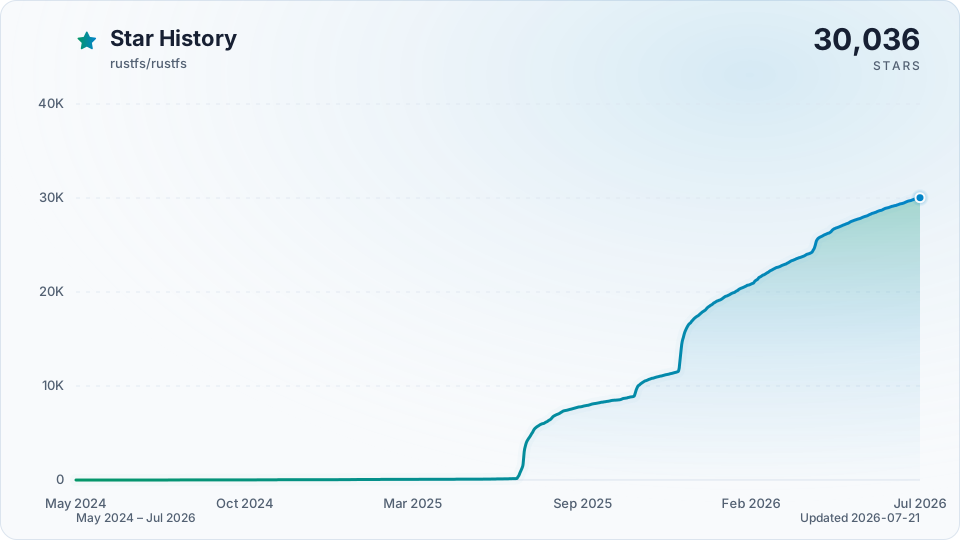
Star History
License
RustFS is a trademark of RustFS, Inc. All other trademarks are the property of their respective owners.