 Ben Potter
8a4adeec32
Ben Potter
8a4adeec32
Closes https://github.com/coder/coder/issues/15675 Dev servers that bind to the IPv6 wildcard address (Next.js, Node's default `http.Server`, Go's `net.Listen` on wildcard addresses, and others) never showed up in the dashboard Ports panel, even though they were listening and reachable. The agent's port scanner only called `netstat.TCPSocks`, which reads `/proc/net/tcp` (IPv4 only); an `[::]` dual-stack socket lives exclusively in `/proc/net/tcp6`, so the panel reported "No open ports were detected." Also scan `netstat.TCP6Socks` and merge the results into the existing dedupe loop. The IPv6 scan failure is non-fatal so hosts with IPv6 disabled (missing `/proc/net/tcp6`, Windows with the v6 stack off) keep their IPv4 results instead of the Ports panel 500ing. Both captures below: `python3 -m http.server 5123 --bind ::` running in the same workspace, built from main vs this branch ([full recordings](https://github.com/coder/coder/tree/recordings/recordings/ipv6-listening-ports)). ## Before 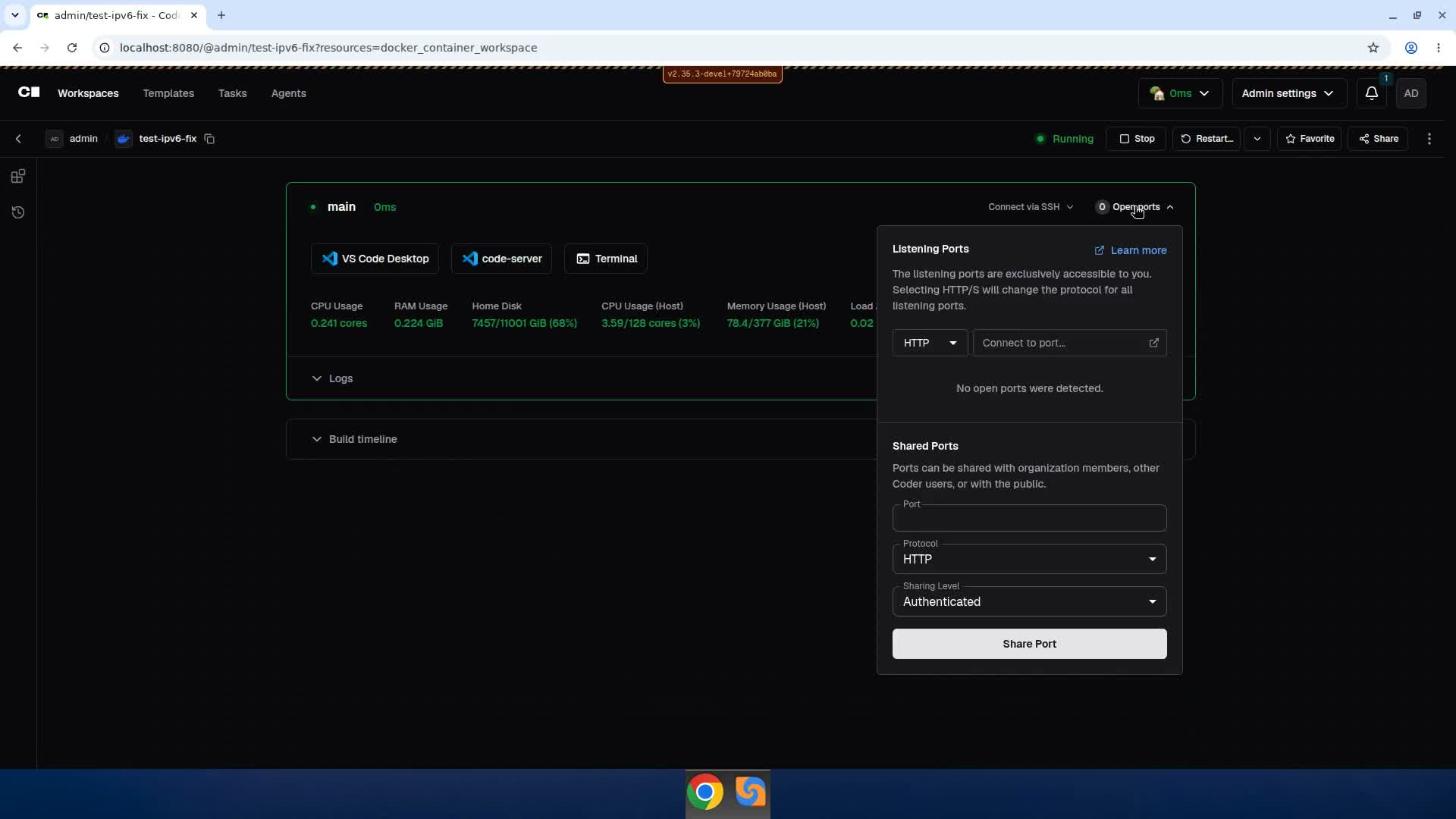 ## After  <details> <summary>Debugging and decision log</summary> - Reproduced on a dogfood workspace: `next-server` listening on `*:3000` per `ss -tlnp`, `curl` returning 200, but `GET /api/v2/workspaceagents/{agent}/listening-ports` returning `{"ports": []}`. Port 3000 (hex `0BB8`) present in `/proc/net/tcp6`, absent from `/proc/net/tcp`. - Confirmed `agent/ports_supported.go` only calls `netstat.TCPSocks`; the library's `TCP6Socks` (parses `/proc/net/tcp6` on Linux, `GetTcp6Table2` on Windows) was never referenced. - Control test: an IPv4-bound (`0.0.0.0`) listener was detected correctly, isolating the bug to the missing IPv6 scan. - Made the IPv6 scan failure non-fatal after review: returning an error would break the entire ports endpoint (HTTP 500 on every poll) on IPv6-disabled hosts, a regression from the current behavior of "IPv4 ports only." Silent fallback matches the spirit of `ports_unsupported.go`, which returns an empty list rather than erroring. - The fix lives in the OS-backed `osListeningPortsGetter` behind the `ListeningPortsGetter` interface from #20842, so the fake used by coderd tests is unaffected. - Dedupe by port in the existing `seen` map covers dual-stack sockets that appear in both tables on Windows. - `TestOSListeningPortsGetter_IPv6` listens on `[::]:0` and asserts detection; it skips when the host can't bind IPv6. Verified it fails against the pre-fix code. </details> > 🤖 This PR was opened by [Coder Agents](https://coder.com/docs/ai-coder/agents) on behalf of @bpmct.








Coder is a self-hosted platform for cloud development environments and AI coding agents. Workspaces are defined with Terraform, connected through a secure Wireguard® tunnel, and automatically shut down when not used. Coder Agents runs a native AI coding agent whose loop executes in the control plane on your infrastructure, with no API keys in workspaces.
- Define cloud development environments in Terraform
- EC2 VMs, Kubernetes Pods, Docker Containers, etc.
- Automatically shutdown idle resources to save on costs
- Onboard developers in seconds instead of days
- Delegate coding work to AI agents on your infrastructure
- Bring any model (Anthropic, OpenAI, Google, Bedrock, self-hosted)
- No LLM credentials in workspaces, user identity on every action
- Centralized model governance, cost tracking, and audit logging

Quickstart
The most convenient way to try Coder is to install it on your local machine and experiment with provisioning cloud development environments using Docker (works on Linux, macOS, and Windows).
# First, install Coder
curl -L https://coder.com/install.sh | sh

# Start the Coder server (caches data in ~/.cache/coder)
coder server

# Navigate to http://localhost:3000 to create your initial user,
# create a Docker template and provision a workspace
Install
The easiest way to install Coder is to use the
install script for Linux
and macOS. For Windows, use the latest ..._installer.exe file from GitHub
Releases.
curl -L https://coder.com/install.sh | sh
You can run the install script with --dry-run to see the commands that will be used to install without executing them. Run the install script with --help for additional flags.
See install for additional methods.
Once installed, you can start a production deployment with a single command:
# Automatically sets up an external access URL on *.try.coder.app
coder server

# Requires a PostgreSQL instance (version 13 or higher) and external access URL
coder server --postgres-url <url> --access-url <url>
Use coder --help to get a list of flags and environment variables. See the install guides for a complete tutorial.
Documentation
Browse the documentation or visit a specific section below:
- Workspaces: Workspaces contain the IDEs, dependencies, and configuration information needed for software development
- Templates: Templates are written in Terraform and describe the infrastructure for workspaces
- Coder Agents: Delegate coding work to AI agents running on your self-hosted infrastructure
- Administration: Learn how to operate Coder
- Premium: Learn about paid features built for large teams
- IDEs: Connect your existing editor to a workspace
Support
Feel free to open an issue if you have questions, run into bugs, or have a feature request.
Join our Discord to provide feedback on in-progress features and chat with the community using Coder!
Integrations
New integrations are always in progress. Open an issue to request one. Contributions are welcome in any official or community repository.
Official
- Coder Registry: Templates, modules, and integrations for common development environments
- VS Code Extension: Open any Coder workspace in VS Code with a single click
- JetBrains Toolbox Plugin: Open any Coder workspace from JetBrains Toolbox with a single click
- JetBrains Gateway Plugin: Open any Coder workspace in JetBrains Gateway with a single click
- Dev Containers: Build development environments using
devcontainer.jsonon Docker, Kubernetes, and OpenShift - Kubernetes Log Stream: Stream Kubernetes Pod events to the Coder startup logs
- Self-Hosted VS Code Extension Marketplace: A private extension marketplace that works in restricted or airgapped networks integrating with code-server.
- GitHub Actions: An action to set up the Coder CLI in GitHub workflows
Community
- Community Templates: Community-contributed workspace templates in the Coder Registry
- Community Modules: Community-contributed modules to extend Coder templates
- Provision Coder with Terraform: Provision Coder on Google GKE, Azure AKS, AWS EKS, DigitalOcean DOKS, IBMCloud K8s, OVHCloud K8s, and Scaleway K8s Kapsule with Terraform
- Coder Template GitHub Action: A GitHub Action that updates Coder templates
- Discord: Chat with the community and provide feedback on in-progress features
Contributing
New contributors are always welcome. If you are new to the Coder codebase, see the contribution guide to get started.
Hiring
Apply on the careers page if you are interested in joining the team.