 Bryan
3f7781403d
Fixes #210 - this isPR implements `coder login` in the case where the default user is already created. This change adds: - A prompt in the case where there is not an initial user that opens the server URL + requests a session token - This ports over some code from v1 for the `openURL` and `isWSL` functions to support opening the browser - A `/api/v2/api-keys` endpoint that can be `POST`'d to in order to request a new api key for a user - This route was inspired by the v1 functionality - A `cli-auth` route + page that shows the generated api key - Tests for the new code + storybook for the new UI The `/cli-auth` route, like in v1, is very minimal: <img width="624" alt="Screen Shot 2022-02-16 at 5 05 07 PM" src="https://user-images.githubusercontent.com/88213859/154384627-78ab9841-27bf-490f-9bbe-23f8173c9e97.png"> And the terminal UX looks like this: 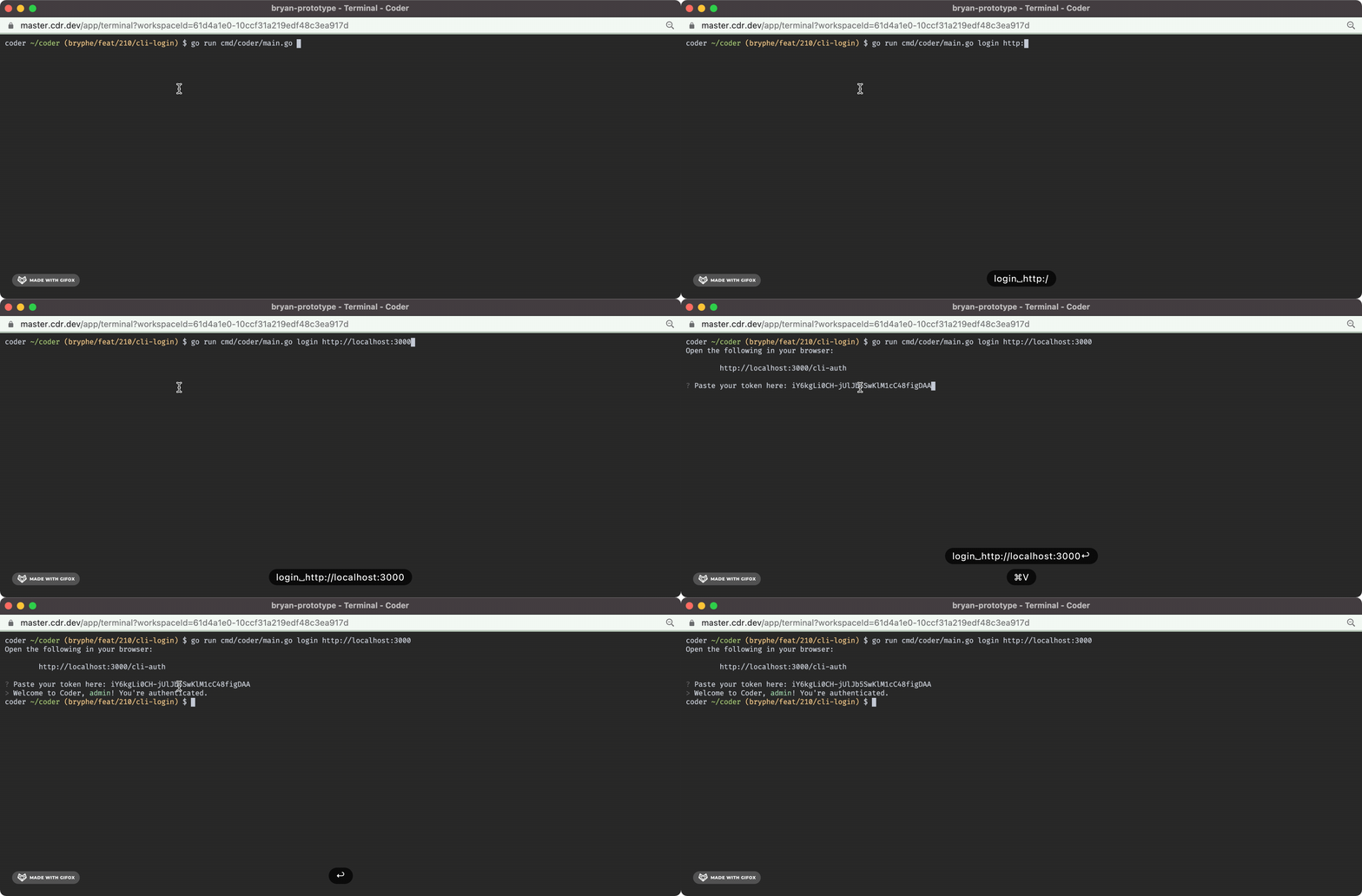




Coder v2
This repository contains source code for Coder V2. Additional documentation:
Directory Structure
.github/: Settings for Dependabot for updating dependencies and build/deploy pipelines with GitHub Actions.semantic.yaml: Configuration for semantic pull requests
site: Front-end UI code.
Development
Pre-requisites
gitgoversion 1.17, with theGOPATHenvironment variable setnodeyarn
Cloning
git clone https://github.com/coder/codercd coder
Building
make buildmake install
The coder CLI binary will now be available at $GOPATH/bin/coder
Development
./develop.sh
The develop.sh script runs the server locally on port 3000, and runs a hot-reload server for front-end code on 8080.
Front-End Plan
For the front-end team, we're planning on 2 phases to the 'v2' work:
Phase 1
Phase 1 is the 'new-wine-in-an-old-bottle' approach - we want to preserve the look and feel (UX) of v1, while testing and validating the market fit of our new v2 provisioner model. This means that we'll preserve Material UI and re-use components from v1 (porting them over to the v2 codebase).
Phase 2
Phase 2 is the 'new-wine-in-a-new-bottle' - which we can do once we've successfully packaged the new wine in the old bottle.
In other words, once we've validated that the new strategy fits and is desirable for our customers, we'd like to build a new, v2-native UI (leveraging designers on the team to build a first-class experience around the new provisioner model).