mirror of
https://github.com/coder/coder.git
synced 2026-09-21 20:51:01 +08:00
f7a0de7a11eba67d330265d5317f6bf20243d20c
15907
Commits
| Author | SHA1 | Message | Date | |
|---|---|---|---|---|
 Michael Suchacz Michael Suchacz
|
f7a0de7a11 |
fix: harden org-scoped MCP config chat gating, updates, and visibility (#28065)
Hardens the org-scoped MCP server config surface from #27942 with fixes and regression pins that are independent of the core cutover: - Keep chats sendable after a selected MCP server is disabled (persisted selections are exempt from message-time rejection). - Keep cached MCP selections usable after a background refetch error (gate the composer on missing data, not `isSuccess`). - Merge PATCH updates onto the current row so unset fields are not clobbered. - Give auditors the full management view of MCP configs their audit logs reference (site and org auditor roles). - Regression pins: frozen OAuth2 callback path, cross-org concealment for item routes, OAuth callback token binding, and disconnect responses indistinguishable from nonexistent config IDs. - Storybook: semantic textbox queries in MCP loading stories; docs note that the MCP settings page needs deployment access. ## Stack context Part of the MCP org-separation stack (CODAGT-711 org scope -> apidocs -> hardening -> CODAGT-717 audit -> CODAGT-712 ACLs -> CODAGT-806 token RBAC). Split out of #27942 to keep the core cutover reviewable; each change here builds on the org-scoped routes and chat gating introduced below it. > Mux (AI agent) authored this PR on Mike's behalf. <!-- mux-attribution: model=claude-fable-5 thinking=high --> |
||
|
TJ
|
dd43574990 |
refactor: remove AI add-on badge, seat column, and add-on wording leftovers (#28004)
Removes all "AI add-on" labeling from the UI, plus two leftover "AI
Governance add-on" wording items from the licensing repackaging (AI
Governance is now included with Premium).

- Remove the **AI add-on** badge from the group settings AI budget
section and the AI Governance add-on card on the Licenses page.
- Remove the **AI add-on** column (check icon showing AI seat
consumption) from the Users and Organization Members tables, along with
its help popover, the `AISeatCell` component, and the
`shouldShowAISeatColumn` entitlement helper.
- Update related Storybook stories.
- Drop "add-on" from the AI cost control route comments in
`enterprise/coderd/coderd.go` and the `coder exp ai-model-prices`
prerequisite in `docs/ai-coder/ai-gateway/cost-controls.md` (leftovers
not covered by #28075/#28077/#28268).

The `has_ai_seat` API field is left intact.

<details>
<summary>Removal scope</summary>

Badge usages removed:

- `site/src/pages/GroupsPage/GroupSettingsPageView.tsx`
-
`site/src/pages/DeploymentSettingsPage/LicensesSettingsPage/AIGovernanceAddOnCard.tsx`

AI seat column plumbing removed:

- `site/src/pages/UsersPage/UsersTable.tsx` and `UsersPage.tsx`
- `site/src/pages/OrganizationSettingsPage/OrganizationMembersTable.tsx`
and `OrganizationMembersPage.tsx`
- `site/src/modules/users/AISeatCell.tsx` (deleted)
- `AiAddonHelpPopover` in `site/src/modules/users/UserHelpPopovers.tsx`
- `shouldShowAISeatColumn` in
`site/src/modules/dashboard/entitlements.ts`

Add-on wording leftovers:

- `enterprise/coderd/coderd.go`: 7 route comments (comments only, no
behavior change)
- `docs/ai-coder/ai-gateway/cost-controls.md`: model prices CLI
prerequisite

</details>

---

🤖 This pull request was generated by Coder Agents on behalf of
@tracyjohnsonux.
|
||
|
Michael Suchacz
|
f2bc9ab1f5 |
docs: complete swagger annotations for organization-scoped MCP routes (#28064)
Adds the missing swagger annotations for the eight organization-scoped MCP server config routes introduced in #27942 and checks in the regenerated API artifacts (`coderd/apidoc`, `docs/reference/api`). No behavior changes: 58 hand-written annotation lines, the rest is generated output. ## Stack context Part of the MCP org-separation stack (CODAGT-711 org scope -> apidocs -> hardening -> CODAGT-717 audit -> CODAGT-712 ACLs -> CODAGT-806 token RBAC). Split out of #27942 to keep the core cutover reviewable; these routes live under `/api/experimental`, where main already ships several MCP handlers without annotations, so the base PR is consistent with existing precedent until this lands. Closes nothing on its own; documentation completion for CODAGT-711. > Mux (AI agent) authored this PR on Mike's behalf. <!-- mux-attribution: model=claude-fable-5 thinking=high --> |
||
|
Michael SuchaczandMathias Fredriksson
|
443e3b9b80 |
feat!: org-scope MCP server configs with RBAC (#27942)
Moves `mcp_server_configs` from deployment scope to organization scope
so each organization fully controls the MCP servers its members can use
with Coder Agents.

## Summary

- Migration: adds `organization_id` (NOT NULL, FK) and keeps existing
rows as the default organization's originals with credentials intact.
Other organizations start with no MCP servers and configure their own;
nothing is copied across organizations. Chats outside the default
organization keep any now-cross-organization `mcp_server_ids` entries;
the runtime already ignores IDs that do not resolve in the chat's
organization, so no data rewrite is needed. Slug uniqueness becomes
`(organization_id, slug)`.
- RBAC: new org-scoped `ResourceMCPServerConfig` with regosql converter
and `GetAuthorizedMCPServerConfigs`; org admins get in-org CRUD, org
members get read (replaced by ACL evaluation in the follow-up ACL PR in
this stack).
- API: all config routes nest under the organization, matching
templates: `POST|GET
/api/experimental/organizations/{organization}/mcp-servers` and
`GET|PATCH|DELETE .../mcp-servers/{mcpserverconfig}` (plus
`oauth2/connect`), resolved by a read-only param middleware that
conceals read-denied and cross-organization access as 404. Two routes
stay on the frozen `/api/experimental/mcp/servers/{mcpServer}` block:
the OAuth2 callback (the redirect URI baked into existing AS-side client
registrations) and `oauth2/disconnect`, which must remain reachable by
users removed from the organization so they can still revoke their token
grant.
- Chat runtime: selection validation and generation resolve configs
strictly by IDs, enabled state, and the chat's organization in SQL;
requested duplicates are normalized; invalid or cross-org IDs are
rejected with the precise ID list. IDs already persisted on a chat are
exempt from message-time rejection so disabling a selected server never
blocks sends; generation skips servers that are no longer usable.
- Frontend: API layer and admin settings pages target the new endpoints.
The admin page manages the default organization's servers; the org
picker is tracked separately (CODAGT-714).

- Security hardening from review: OAuth user grants are additionally
bound to `oauth2_revocation_url` (changing it invalidates grants, and a
racing OAuth callback gets 409 instead of recreating a grant).
Stack-wide SSRF protection for MCP config-directed traffic was split
into its own PR at the top of this stack (#28242) to keep this diff
reviewable; this PR keeps main's existing discovery IP-range guard.
OAuth2 auto-discovery now completes before the config row is inserted: a
failed discovery persists nothing, and there is no provisional row that
concurrent updates could race against.

Two follow-up PRs in this stack were split out to keep this diff
reviewable: #28064 completes the swagger annotations for the moved
routes (main already ships these experimental MCP handlers unannotated),
and #28065 carries hardening fixes and regression pins on top of the
cutover.

- Force On enforcement (landed on main mid-review) is org-scoped: the
forced set is read per chat organization
(`GetForcedMCPServerConfigsByOrganization`), so another organization's
`force_on` server never attaches to a chat.

## Breaking changes (experimental API)

The MCP server config endpoints move from the deployment-scoped
`/api/experimental/mcp/servers` block to organization-nested paths:
`POST|GET /api/experimental/organizations/{organization}/mcp-servers`
and `GET|PATCH|DELETE
/api/experimental/organizations/{organization}/mcp-servers/{mcpserverconfig}`
(plus `oauth2/connect`). The old paths are removed, so API consumers
must supply an organization. Two routes intentionally stay on the frozen
`/api/experimental/mcp/servers/{mcpServer}` block: the OAuth2 callback
(its redirect URI is baked into existing AS-side client registrations)
and `oauth2/disconnect` (must remain reachable by users removed from the
organization). These endpoints are under `/api/experimental`, so no
deprecation window is provided.

## Rolling upgrades

During a rolling deploy, an old replica creating an MCP config can fail
the new `NOT NULL organization_id` constraint until it is upgraded
(reads are unaffected: old binaries' generated queries select their own
column lists). This matches the repo's existing precedent for additive
NOT NULL migrations (000562) and affects only the admin config-create
path in the upgrade window.

Upgrades are expected to run in scheduled maintenance downtime with the
database locked during migration, so the migration ships no
rolling-upgrade compatibility machinery. The down migration deletes
organization-created configs (their chat references are cleaned by the
000510 delete trigger) and restores deployment-wide slug uniqueness.

Part of the MCP org-separation stack (CODAGT-711 -> CODAGT-717 audit ->
CODAGT-712 ACLs -> CODAGT-806 token RBAC).

Closes https://linear.app/codercom/issue/CODAGT-711

UAT: validated end to end on a two-org dogfood deployment, including a
real pre-migration to post-migration upgrade, cross-org isolation
(404s), same-slug-two-orgs, chat selection gating, and a live MCP tool
call through the org-scoped generation path. The migration was later
revised to keep existing rows in the default organization only (no
per-organization copies); that revision is covered by the migration test
suite.

> Mux (AI agent) authored this PR on Mike's behalf.

<!-- mux-attribution: model=claude-fable-5 thinking=high -->

---------

Co-authored-by: Mathias Fredriksson <mafredri@gmail.com>
|
||
|
Atif Ali
|
7ff1278ab3 |
feat: track Junie as an AI Gateway client (#28266)
## Problem Junie CLI works with AI Gateway, but every Junie session is recorded as `Unknown`. Junie sends `User-Agent: Junie:SNAPSHOT` (observed directly from the CLI), which `GuessClient` does not match, so usage, spend, and audit views cannot attribute Junie traffic. There were also no docs for pointing Junie at AI Gateway. ## Fix - Detect the observed `junie:` user-agent prefix and add the `Junie` client value. - Add the Junie icon so sessions render with a logo instead of the fallback question mark. - Add a Junie client page and list it in the compatibility table. - Add `Roo Code` and `Charm Crush` to the documented `client` filter values. Both were already implemented but missing from the list. ## Supported configurations | Provider | API type | Endpoint | |-----------|-------------------|--------------------------| | OpenAI | `OpenAIResponses` | `/openai/v1/responses` | | Anthropic | `Anthropic` | `/anthropic/v1/messages` | BYOK works on both through `extraHeaders` with `X-Coder-AI-Governance-Token`. Preview: https://coder.com/docs/@matifali-junie-ai-gateway-client/ai-coder/ai-gateway/clients/junie > 🤖 This PR was created with the help of Coder Agents, and needs a human review. 🧑💻 |
||
|
Phorcys 🐾
|
1bb0978361 |
fix(site): centralize UUID generation and fix non-secure crash (#28285)
Fixes OSS-38: `crypto.randomUUID is not a function` when accessing Coder over plain HTTP. ### Root cause `crypto.randomUUID` is only defined in secure contexts (HTTPS or localhost). It is `undefined` when Coder is served over plain HTTP. The `uuid` package's `v4()` short-circuits to `crypto.randomUUID()` when it is truthy, and in the production bundle that path compiles down to a direct `crypto.randomUUID()` call, so `uuidv4()` throws over HTTP. Observed crash (Template Builder, in the `useMemo` that mints the telemetry session ID): ``` TypeError: crypto.randomUUID is not a function Rt/h<@.../assets/TemplateBuilderPage-*.js useMemo@... ``` The same `uuidv4()` path backed the Terminal reconnection token and the Agent chat tab IDs / reconnection tokens, so those flows were affected too. ### Fix Add a single `generateUUID` helper in `site/src/utils/random.ts` that derives the UUID from `crypto.getRandomValues` (the one `Crypto` member available in insecure contexts) and only calls `crypto.randomUUID` when it actually exists. Route all client-side UUID generation through it, so every call site is fixed at once and future ones stay safe. ### Changes | Change | Route | Human tested/verified | |---|---|---| | `utils/random.ts` — new `generateUUID()` helper | N/A | N/A | | `TemplateBuilderPage.tsx` — telemetry session ID | `/templates/new/builder` | [x] | | `TerminalPage.tsx` — reconnection token | `/:username/:workspace/terminal` | [x] | | `AgentChatPageView.tsx` — tab IDs + reconnection tokens | `/agents/:agentId` | [ ] | | `useChatDraftAttachments.ts` — draft client IDs | `/agents/:agentId` | [x] | | `TaskApps.stories.tsx` — mock app IDs (Storybook) | `/tasks/:username/:taskId` | [ ] | | `WorkspaceSharingIndicator.stories.tsx` — mock actor IDs (Storybook) | `/workspaces` | [ ] | | Removed unused `uuid` / `@types/uuid` direct deps | N/A | N/A | `uuid` is still pinned via a `pnpm.overrides` entry because `mermaid`/`streamdown` depend on it transitively. ### Tests - `random.test.ts` covers a valid UUID, uniqueness, and the insecure-context path (with `crypto.randomUUID` stubbed to `undefined`). - `TerminalPage.test.tsx` now mocks `#/utils/random` instead of the `uuid` module. ### Validation - `make fmt`, `biome check`, `tsc --noEmit` clean - `vitest run` green: `random.test.ts` (6), `TerminalPage.test.tsx` (16), `useChatDraftAttachments.test.ts` (17), both changed stories (12) - Reproduced the original crash over HTTP on a production build, top frame `uuidv4()` in Template Builder. --- _This PR was generated by Coder Agents on behalf of @phorcys420._ |
||
|
Jiachen Jiang
|
6107cfe918 |
fix(enterprise/coderd/license): remove AI Governance required banner (#28268)
## Summary The AI Governance add-on is now included in all Premium licenses, so the transitional license banner warning that AI Bridge / AI Gateway requires the AI Governance add-on is no longer accurate. This removes that warning throughout Coder. The banner text this removes: > The AI Governance add-on is required to use AI Gateway. Please reach out to your account team or sales@coder.com to learn more. ## Changes - Remove the AI Bridge soft warning block in `LicensesEntitlements`. - Remove the now-unused `hasExplicitAIBridgeEntitlement` tracking that only fed that warning. - Remove `TestAIBridgeSoftWarning` and the vestigial warning assertions/comments that pinned the removed behavior. The license banner surfaces backend entitlement warnings verbatim, so removing the warning here removes it from the dashboard banner. No frontend changes are needed; the warning string existed only in the backend. ## Testing - `go build ./enterprise/coderd/license/...` - `go vet ./enterprise/coderd/license/...` - `go test ./enterprise/coderd/license/` (license entitlement + AI Governance addon suites) --- *This PR was created by Coder Agents on behalf of @jcjiang.* |
||
|
Nick Vigilante
|
e003014ff8 |
docs: remove space in GitHub-style callout markers [DOCS-680] (#28305)
## What Normalize the one GitHub-style callout marker that had a space after `!` to the canonical tight form. - `docs/user-guides/workspace-access/jetbrains/gateway.md`: `> [! WARNING]` -> `> [!WARNING]` A full-corpus scan confirmed this was the only spaced marker. ## Why GitHub alerts, the hosted docs (coder.com), and the offlinedocs Fumadocs renderer all require the tight `> [!WARNING]` form. The spaced form rendered as literal `[! WARNING]` text instead of a styled alert, so this is a genuine rendering fix on GitHub and coder.com, not an offline-pipeline accommodation. Surfaced by the offlinedocs Fumadocs migration review (CRF-60 on #27390). Tracked separately from the mixed-case uppercasing fix (DOCS-681), per request. Linear: [DOCS-680](https://linear.app/codercom/issue/DOCS-680/remove-the-space-after-in-github-style-callout-markers-across-docs) > This PR was created with AI assistance (Coder Agents). |
||
|
Nick Vigilante
|
2ee6f459b2 |
docs: uppercase mixed-case GitHub-style callout markers [DOCS-681] (#28304)
## What Uppercase the mixed-case GitHub-style callout markers in the docs corpus to the canonical all-caps form. - `docs/install/rancher.md`: `> [!Important]` -> `> [!IMPORTANT]` - `docs/user-guides/shared-workspaces.md`: `> [!Important]` -> `> [!IMPORTANT]` - `docs/user-guides/workspace-access/index.md`: `> [!Note]` -> `> [!NOTE]` A full-corpus scan confirmed these were the only mixed-case markers. ## Why GitHub alerts, the hosted docs (coder.com), and the offlinedocs Fumadocs renderer all require all-caps alert types (`[!NOTE]`, `[!IMPORTANT]`, and so on). The mixed-case form rendered as literal text instead of a styled alert (on some pages directly next to a correctly-rendered all-caps alert), so this is a genuine rendering fix on GitHub and coder.com, not an offline-pipeline accommodation. Surfaced by the offlinedocs Fumadocs migration review (CRF-60 on #27390). Tracked separately from the space-after-`!` fix (DOCS-680), per request. Linear: [DOCS-681](https://linear.app/codercom/issue/DOCS-681/uppercase-mixed-case-github-style-callout-markers-across-docs) > This PR was created with AI assistance (Coder Agents). |
||
|
Cian Johnston
|
023f61626d |
feat: default AI Gateway sessions list to a 24h time range (#28256)
The AI Gateway sessions list page takes 5-13 seconds to load because `ListAIBridgeSessions` scans all `aibridge_interceptions` rows (~1M on dogfood) when no time filter is set. This PR defaults the list to the last 24 hours of sessions, reducing the scan by roughly two orders of magnitude without any backend or migration changes: the `started_after`/`started_before` filters already exist end-to-end in SQL, searchquery, and the API. The default range is held in component state (not the URL) and merged into every query payload including prefetches, so the unbounded query never runs on page load. A time range filter in the filter bar lets users override the window explicitly, which doubles as a forensic tool. Picking a range writes quoted RFC 3339 timestamps into the existing filter query. There are no presets and no unbounded "all time" mode, so the fast path is the only path. Existing "All sessions"/"My sessions" presets reset the filter query, which resets the time window to the default 24 hours; that is intentional. Also makes the five filter triggers a uniform width and left-aligns the new picker so the search input keeps room on wide viewports. Depends on #28255 (the DateTimeRangeFilter component) and #28254 (filterQuery serialization). Part of [AIGOV-580](https://linear.app/codercom/issue/AIGOV-580/ai-gateway-sessions-page-takes-5-10-seconds-to-load) --- _Generated by Coder Agents on behalf of @johnstcn._$ --- **Stack:** #28254 (filterQuery fix) \u2192 #28255 (component) \u2192 #28256 (sessions page) |
||
|
Yevhenii Shcherbina
|
05699c4d55 |
feat: automate weekly AI model price book refresh (#28146)
Example of generated PR: https://github.com/coder/coder/pull/28228 ## Summary The price book is regenerated by hand with `make gen/aibridge-prices`, so keeping it current depends on someone remembering to run it. Newly launched models stay unpriced and changed prices stay stale until the next manual run. This adds a weekly workflow that regenerates both artifacts from live [models.dev](https://models.dev) data and opens a pull request when the output changes. For scale, a run against `main` today produced 32 models added, 11 removed, and 43 repriced. ## What it does - Runs every Thursday at 09:00 UTC, plus `workflow_dispatch`. Exits without opening anything when regeneration produces no diff. - Reuses one branch and one pull request, force-pushing each week, so at most one refresh PR is open and it always carries the newest snapshot. - Ships `prices.json` and `knownModelsGenerated.json` together, since both come from a single upstream snapshot. - Never merges automatically. Prices are customer-visible cost numbers, so every change goes through human review. - Announces failures in Slack. The generator fails by design when upstream drops a model pinned in `overrides.jq` or curated in `curation.json`, and a silently red weekly cron would defeat the point. `scripts/aibridgepricesdiff` renders the PR body summary: counts, then the models added, removed, and repriced. Exact figures stay in the diff rather than being restated in the body. It is deterministic and unit tested rather than AI-generated, so the model lists cannot drift from the file. `CODEOWNERS` covers the two generated artifacts, which are exactly the files a refresh PR touches. ## Verification Ran on this branch via a temporary `push` trigger, since `schedule` and `workflow_dispatch` only fire from the default branch. Confirmed end to end: mise and pnpm setup, generation from live models.dev, change detection, summary and body assembly, commit under the bot identity, branch creation, force-push on the second run, and Slack delivery. `gh pr create` and `gh pr edit` remain unverified: both runs hit `HTTP 503` from `api.github.com/graphql` during a GitHub major outage. The push path itself succeeded, so the credential and permissions are proven. Also verified locally: `go test ./scripts/aibridgepricesdiff/`, `make lint/actions/actionlint`, `make lint/actions/zizmor`, and `make pre-commit`. ## Notes - The PR is opened with `secrets.CDRCI_GITHUB_TOKEN`. PRs opened with the default `GITHUB_TOKEN` do not trigger workflow runs, which would leave the refresh without CI signal on a file that feeds cost calculation. - Requires the `AIGATEWAY_PRICES_SLACK_WEBHOOK` repository secret. The notification step fails loudly if it is unset, since by then the refresh has already failed and nobody would be told. - The workflow installs pnpm dependencies because catalog generation formats its output with biome; without `site/node_modules` the formatting step silently no-ops and an unformatted file would be committed. - A refresh that lands after a release branch is cut can reach that release through the existing cherry-pick label, so no separate release-cut trigger is included. The label is not applied automatically; that stays a reviewer decision. - Identifiers keep the `aibridge` spelling where they name real paths and make targets (`coderd/aibridge/prices`, `make gen/aibridge-prices`, `scripts/aibridgepricesgen`). The workflow itself is named `aigateway-prices-refresh`, and prose says AI Gateway per the style guide. - The issue also asked for code owners on the generator. Only the generated artifacts are owned here, since those are the files a refresh PR touches. Ownership of `curation.json` and `overrides.jq` can be added separately if human edits to them should request review. <details> <summary>Implementation plan and decision log</summary> ### Goal Refresh `make gen/aibridge-prices` output on a schedule and open a human-reviewed PR when it changes, so releases never ship a stale price book. ### Schedule Weekly, Thursdays 09:00 UTC, leaving Thursday, Friday, and Monday for review before Tuesday releases. A monthly run was considered first. Release ships Tuesday morning and the freeze is the last Tuesday before EOM, so a monthly run on the 19th or 20th collapses to 1-2 usable business days in roughly 10 of 132 months: February, when the release Tuesday is the 22nd and the run day falls on a weekend. Measured across 2026-2036: | Cron day | Worst case usable business days | Months with 2 or fewer | Median | |---|---|---|---| | 20th | 1 | 10 | 6 | | 19th | 1 | 10 | 6 | | 16th | 3 | 0 | 6 | | Weekly Thursday | n/a, always a full week | 0 | n/a | The median is 6 days for every candidate, so moving to weekly costs nothing and removes the bad tail. The shipped book is never more than 7 days stale. ### Branch strategy One fixed branch, force-pushed, rather than a new branch and PR per run. `prices.json` is a full regeneration from the current upstream snapshot, not an incremental patch, so two open refresh PRs are the same file at two points in time and the older one is strictly wrong. A single PR makes merging a stale snapshot impossible, keeps reviewer load at one PR, and avoids a full CI run per week per stale PR. ### Summary generation Deterministic Go tool, not an AI summary. An LLM summarizing a JSON diff can drop or invent a row, and would be non-reproducible run to run. A jq implementation was considered and rejected as effectively untestable. The body lists which models moved; the diff in the Files tab remains the source of truth for figures. An earlier version rendered full price tables with percentage deltas. That duplicated the diff, so it was reduced to model lists. ### Token `secrets.CDRCI_GITHUB_TOKEN`, the cdrci machine user already used for bot-authored PRs in `release.yaml` and cited for exactly this reason in the commented-out `update-flake` job in `ci.yaml`. A dedicated GitHub App scoped to this repo would be tighter, but needs org admin to create. ### Commit identity `github-actions[bot]` with its numeric noreply address, matching `backport.yaml` and `cherry-pick.yaml`. An invented address would leave refresh commits with an unlinked author. ### Alerting A dedicated webhook secret rather than reusing `CI_FAILURE_SLACK_WEBHOOK`. The repo already splits alerting per domain (docs, security, dependabot each have their own webhook), and the CI-failure channel carries a user mention plus `vars.BLINK_CI_FAILURE_PROMPT` that feeds an automated triage flow this payload does not belong in. GitHub's built-in email notification was considered and rejected as the primary channel: for scheduled workflows it goes to a single user, the one who last modified the cron syntax, and cannot be routed to a team. ### Out of scope Triggering a refresh when a release branch is cut. The existing cherry-pick label already gets a late refresh into a release, so a separate mechanism is unnecessary. </details> --- Closes [AIGOV-578](https://linear.app/codercom/issue/AIGOV-578/automate-updates-to-the-shipped-ai-model-price-book). Authored by Coder Agents on behalf of @evgeniy-scherbina. |
||
|
Atif Ali
|
7268cada94 |
docs: remove JetBrains Fleet references (#28301)
## Summary The `jetbrains-fleet` module was removed from [registry.coder.com](https://registry.coder.com) and `coder/registry`, but the docs still pointed users at Fleet and at the now-dead module page. ## Changes - Removed `docs/user-guides/workspace-access/jetbrains/fleet.md` and its screenshot - Removed the Fleet entry from `docs/manifest.json` - Dropped Fleet from the supported IDE lists in `jetbrains/index.md` and `workspace-access/index.md` - Glossary: replaced the Fleet link with Toolbox - Contributing guide: replaced the dead `jetbrains-fleet` registry link with `jetbrains` ## Validation - No remaining Fleet references in `docs/` (the only match left is Tailscale's "global fleet of DERP relays") - `docs/manifest.json` parses, `pnpm run lint-docs` reports 0 errors Preview: https://coder.com/docs/@docs-remove-jetbrains-fleet/user-guides/workspace-access/jetbrains > [!NOTE] > `site/static/icon/fleet.svg` and its entry in `site/src/theme/icons.json` are intentionally left in place. Removing the icon would break existing templates that reference that path. > The deleted page will 404 until a redirect is added in the website repo. > 🤖 This PR was created with the help of Coder Agents, and needs a human review. 🧑💻 |
||
|
Jake Howell
|
46c0dba1e9 | fix: standardize EmptyState typography (#27720) | ||
|
Nick Vigilante
|
71b5bc398f |
docs: fix broken callout on the AI Gateway Monitoring page (#28303)
The callout on this page is broken, as flagged by Atif. This PR moves the callout out of the `<details>` block to avoid the broken formatting. Fixes DOCS-679 <!-- If you have used AI to produce some or all of this PR, please ensure you have read our [AI Contribution guidelines](https://coder.com/docs/about/contributing/AI_CONTRIBUTING) before submitting. --> |
||
|
Nick Vigilante
|
fc6d6babfa |
docs: add markdown_url front matter so the About page links to /docs.md (#28281)
The docs About page renders at `/docs/about`, but its Markdown source is the docs root `README.md`, whose Markdown twin is `/docs.md`. The path-derived mapping (`/docs/about` -> `/docs/about.md`) points the "Copy page / view as Markdown" affordance and the sitewide `rel="alternate"` link at a URL that 404s for this page. Add a `markdown_url: /docs.md` front-matter override to `docs/README.md`. It is inert for rendering and for `/docs.md` itself (the body still begins at `# About`); it only populates the front matter the docs site reads to advertise the correct Markdown alternate. Reader side: coder/coder.com#1013 (DOCS-638). Neither change breaks without the other, so they can merge in either order. Refs DOCS-678 > This PR was created with AI assistance (Coder Agents). |
||
|
Hugo Dutka
|
c2bb62446d |
fix(coderd): remove per-chat system prompt limit (#28294)
Per-chat system prompts longer than 10,000 characters are rejected during chat creation. Remove that validation so chat creation accepts longer system prompts within the existing request-body limit. |
||
|
Nick Vigilante
|
31e95f7096 | docs: fix prebuilt-workspaces example syntax and defaults (#28088) | ||
|
Ben Potter
|
8a7e8d9d5b |
refactor: move chat prompt sanitization into codersdk (#28283)
Exports `SanitizePromptText` (and its helpers) from `codersdk` instead of `coderd/x/chatd`, so API consumers can sanitize prompt text exactly the way the server stores it. ## Why coder/terraform-provider-coderd#412 adds a `coderd_chat_system_prompt` resource whose `system_prompt` attribute compares values by their sanitized forms (otherwise the trailing newline from `file("system-prompt.md")` is perpetual drift, since the server stores the sanitized value). That currently requires a mirrored copy of the sanitizer in the provider, which can silently rot. Per review there ([discussion](https://github.com/coder/terraform-provider-coderd/pull/412#discussion_r3801110795)), the sanitizer should be exported from `codersdk` and imported instead. ## What - `coderd/x/chatd/sanitize.go` → `codersdk/promptsanitize.go` (pure move; package + doc-comment note about why it lives in codersdk) - `coderd/x/chatd/sanitize_test.go` → `codersdk/promptsanitize_test.go` - Callsites updated (`exp_chats.go`, `chatd.go`, `subagent.go`, `context_prompt.go`); no wrapper left behind, single source of truth - No behavior change > Generated by Coder Agents on behalf of @bpmct |
||
|
Matt Vollmer
|
ddf2d33665 |
docs: update Tallyman Agent Time reporting (#28275)
Moves Coder Agents usage reporting into the Licensing & Usage page and updates the documentation to describe Agent Time and the `hb_agent_runtime_v1` Tallyman payload. Removes the superseded Usage Data Reporting page and its manifest entry, and removes the obsolete AI Governance link to that page. PR generated with Coder Agents |
||
|
TJ
|
97cb722fb8 |
fix: show no budget instead of unlimited for empty group AI budget (#27993)
An empty per-member AI budget on the group settings page previously displayed "unlimited budget" with a "Members in this group have no spending cap." alert. Unlimited spend only applies when the everyone group is the sole group, so this messaging was misleading everywhere else. ## Changes - Empty budget now shows "This group has **no budget** set. View docs" with no info alert. "View docs" links to [Effective group resolution](https://coder.com/docs/ai-coder/ai-gateway/cost-controls#effective-group-resolution) using the versioned `docs()` helper. - Removed the "Members in this group have no spending cap." alert entirely. - Input placeholder changed from `unlimited` to `no budget`. - Updated the `AIBudgetUncapped` story expectations to match. ## Unchanged - Entering an explicit `$0` still shows the "A $0 limit disables AI access for this group." alert, as before. - Saving with an empty field still sends `null` to the budget API; backend semantics are untouched. Story tests pass: `pnpm test:storybook src/pages/GroupsPage/GroupSettingsPageView.stories.tsx` (7/7). --- *This PR was generated by Coder Agents on behalf of @tracyjohnsonux.* |
||
|
Cian Johnston
|
da99941099 |
feat(site): add shared DateTimeRangeFilter component (#28255)
A text-expression datetime range picker with From/To inputs accepting
`now`, a clock time (current day), a date (midnight), or a date with a
clock time. Invalid text gets inline errors, underspecified expressions
resolve on blur, and out-of-order boundaries clamp against the other
one. The trigger derives a concise label ("Last 24 hours", "Apr 10",
"Aug 11 - Today", "Apr 17 - 19").

Placed in `site/src/components/DateTimeRangeFilter/` so other pages can
reuse it. Expression parsing and trigger-label derivation live in
`timeRange.ts` next to the component; both are generic over `Date`
pairs. Depends on #28254 for the shared `filterQuery` serialization
helpers.

Part of
[AIGOV-580](https://linear.app/codercom/issue/AIGOV-580/ai-gateway-sessions-page-takes-5-10-seconds-to-load)

---
_Generated by Coder Agents on behalf of @johnstcn._$

---

**Stack:** #28254 (filterQuery fix) \u2192 #28255 (component) \u2192
#28256 (sessions page)
|
||
|
Paweł Banaszewski
|
63641b98c8 |
fix: treat a missing serve endpoint as a fatal dial error (#27864)
Adds 404 as a terminal error for establishing DRPC connection. A standalone AI Gateway pointed at a coderd that does not expose `/api/v2/ai-gateway/serve` gets a 404, which the connect loop classified as transient and retried forever. Redialing cannot fix a missing endpoint. 404 now is treated as terminal handshake failure. `--url` is expected to point directly at coderd, so a 404 from an intermediary is not distinguished. Refs https://linear.app/codercom/issue/AIGOV-320/write-connection-tests --- Generated with Coder Agents. |
||
|
Danielle Maywood
|
8405bbb26c | feat(site): show best-effort model pricing on the model form (#28290) | ||
|
Atif Ali
|
34e95c46bf |
docs: note JetBrains client attribution in AI Gateway (#28296)
Noticed while testing Junie that JetBrains AI Assistant sends `User-Agent: ktor-client`, the stock Ktor default, so AI Gateway records these sessions as `Unknown`. Admins who enable Gateway for governance won't see their JetBrains attributed in the sessions view or the `client` filter. Documents the behavior on the JetBrains client page. Nothing to fix on our side, matching `ktor-client` would misattribute any other Ktor-based application. |
||
|
Paweł Banaszewski
|
a441b03d70 |
feat: add yaml config option to standalone AI gateway (#28258)
`coder ai-gateway start` now accepts a `--config` / `-c` flag (and `CODER_CONFIG_PATH`) to load configuration from a YAML file. |
||
|
Ethan
|
059546e92a |
ci: skip oversized flake-check selections (#28293)
Skip the targeted Go flake check when a change selects more than 100 tests, and update `whichtests` to the version that supports this limit. Large selections usually come from broad or mechanical changes rather than a narrowly introduced flaky behavior. Repeating hundreds of tests substantially increases runtime and runner resource usage while providing less focused signal; regular CI still exercises the affected test suite across its normal jobs and repetitions. |
||
|
Jim
|
1fbd029754 |
fix(provisioner/terraform): sync version constants with the shipped binary (#27871)
`provisioner/terraform/install.go` still pins `TerraformVersion` to 1.14.5 and `maxTerraformVersion` to 1.14.9, but the shipped binary has been Terraform 1.15.5 since v2.35.0. `scripts/Dockerfile.base`, `install.sh`, `mise.toml`, `mise.lock`, and `flake.nix` all track 1.15.5; only the Go constants were left behind, which makes the `NOTE: Keep this in sync with ...` comments on those constants false. Two user-visible effects on the same release: - Provisioner daemons that have a system Terraform log `installed terraform version newer than expected, you may experience bugs installed_version=1.15.5 max_version=1.14.9` on every startup. The check at [`provisioner/terraform/serve.go#L122-L126`](https://github.com/coder/coder/blob/79723db2d23b6b941e405a8d3c2200206e7e4cb4/provisioner/terraform/serve.go#L122-L126) is warn-only, so the 1.15.5 binary is used anyway and the warning is pure noise. - Hosts *without* a system Terraform fall through to `Install()` at [`serve.go#L105`](https://github.com/coder/coder/blob/79723db2d23b6b941e405a8d3c2200206e7e4cb4/provisioner/terraform/serve.go#L105), which downloads `TerraformVersion`. So the same Coder version provisions with 1.15.5 in some environments and 1.14.5 in others. This sets `TerraformVersion` to 1.15.5 and `maxTerraformVersion` to 1.15.9, keeping the existing `.9` convention that auto-allows patch releases. `minTerraformVersion` is unchanged. No other file needed updating; everything else already tracks 1.15.5. This is a consistency fix, not a CVE remediation. The divergence was already identified as [CRF-2 in the review of #27183](https://github.com/coder/coder/pull/27183#pullrequestreview-4685322854) (`provisioner/terraform/install.go:25`), which noted that leaving the constants behind means "a maintainer who trusts it could 'resync' install.sh/Dockerfile.base back to 1.14.5". That PR was closed for unrelated reasons; this change addresses only the drift. Refs #27183 |
||
|
Matt Vollmer
|
ddcffd8248 | docs: remove inaccurate Agent Firewall filesystem protection claim (#28286) | ||
|
Bobby Ho
|
663f41ffa9 |
feat: derive OAuth2 client type from token_endpoint_auth_method (#28043)
Adds an OAuth2 client type (public vs confidential, RFC 7591 §2) derived from the requested auth method instead of hardcoded confidential. The type is stored and guarded here, but no endpoint enforces on it yet; public behavior at the token endpoint follows in the next PR in the stack. - Client type is derived once and reused by both registration and redirect URI validation, so they can't disagree - IsPublic() fails closed: an unrecognized or missing value reads as confidential - RFC 7592 update (PUT) now rejects moving a client between public and confidential (400) instead of silently flipping it when the auth method is omitted - Discovery still doesn't advertise "none"; follows once the token endpoint honors it ### Behavior by client shape `client_type` is derived from `token_endpoint_auth_method` at POST and pinned at PUT. RFC 7592 GET/PUT authenticate with the registration access token, not the client secret, so neither endpoint reads a secret. | Registered with | Stored `client_type` / method | GET reports | PUT that flips the method | |------------------------------------|---------------------------------------|-----------------------|-----------------------------------------| | omitted, or `client_secret_basic` | `confidential` / `client_secret_basic` | `client_secret_basic` | `none` → 400 `invalid_client_metadata` | | `none` (new) | `public` / `none` | `none` | `client_secret_*` → 400 `invalid_client_metadata` | | `none` (before this PR) | `confidential` / `none` | `none` | either → 200, type stays `confidential` | - PUT still replaces every other RFC 7591 field. `client_type` is the only pinned one; the method may move within a type (`client_secret_basic` ↔ `client_secret_post`). - Row 3 is the only shape where the two columns disagree. The guard fires only on a method change that crosses the type line, so those clients keep managing themselves instead of being locked out of their own configuration endpoint. - The token endpoint does not consult `client_type` yet, so every client still authenticates with a secret and registration still issues one. Split out of #27873, second in the stack (on top of #28041). Refs https://linear.app/codercom/issue/ENG-3029/oauth2-support-public-client |
||
|
Jake Howell
|
4d13bef74d |
feat(site): add Install Coder Desktop item to UserDropdown (#28244)
> 🤖 This PR was modified by Coder Agents on behalf of Jake Howell. Resolves [DEVEX-722](https://linear.app/codercom/issue/DEVEX-722/add-install-coder-desktop-button-to-userdropdown). Adds an **Install Coder Desktop** item to `UserDropdown`, sitting directly above the existing **Install CLI** option. Because `UserDropdownContent` is shared, it appears in both the navbar dropdown and the agents-page sidebar footer. ### Screenshots macOS/Windows shots are captured with `navigator.platform` overridden accordingly; the Linux shot is the real workspace platform, where the Coder Desktop item is hidden. Install Coder Desktop uses a monitor glyph, and Install CLI now uses a terminal glyph (it was a monitor on `main`). | `main` (before) | This PR · macOS/Windows | This PR · Linux / iPad OS | | --- | --- | --- | | 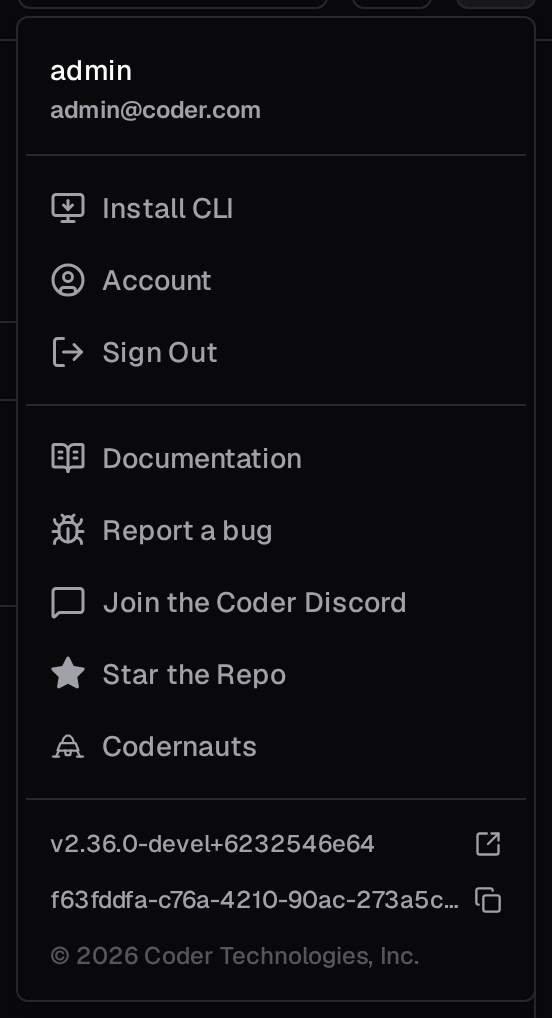 | 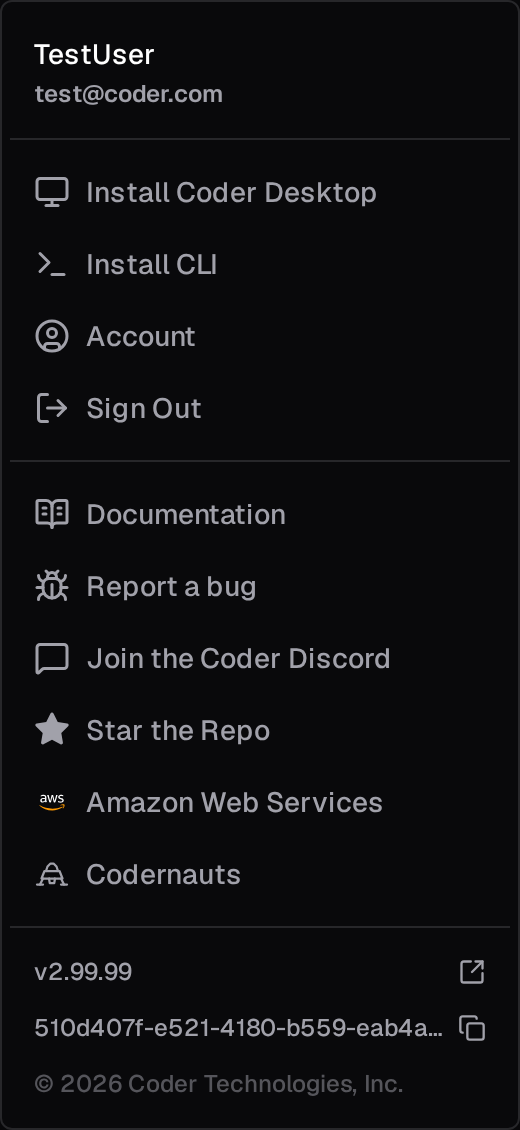 | 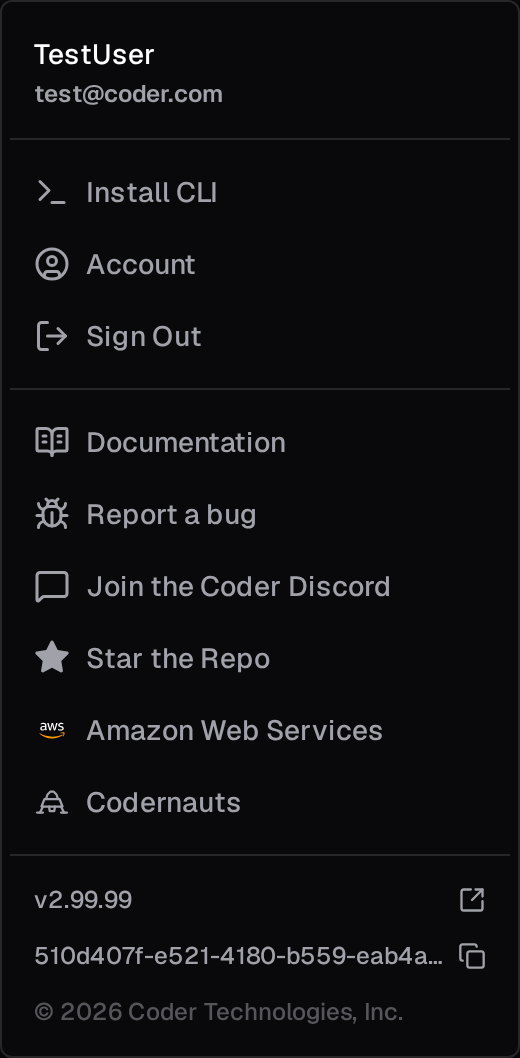 | ### Behaviour - **Platform-gated visibility:** shown only on macOS and Windows (the platforms Coder Desktop ships for), hidden on Linux/other. The Linux client ([coder/coder-desktop-linux](https://github.com/coder/coder-desktop-linux)) is experimental and not advertised yet, so it stays hidden there. - **Links to the docs** (`https://coder.com/docs/user-guides/desktop`) rather than a single install method. The docs page is the canonical hub covering Homebrew, WinGet, manual release downloads, and source, and it stays current without frontend changes. The `coder-desktop-*` repo READMEs don't enumerate install methods; they defer to these same docs. - **No installed-detection:** consistent with the Install CLI item, we don't try to detect whether Coder Desktop is already present. ### Changes - `site/src/utils/platform.ts`: add `isWindows()` and `supportsCoderDesktop()`. - `UserDropdownContent.tsx`: render the platform-gated item (`MonitorIcon`) and switch Install CLI to `TerminalIcon`. - Unit tests for the platform helpers and Storybook coverage for the dropdown item (present + correct href on macOS/Windows, absent on Linux/iPadOS). Implementation plan & decision log **Ticket open questions and decisions** 1. *Shown to all users or only supported platforms?* Only supported platforms (macOS, Windows); hidden elsewhere. The Linux client is experimental and not advertised yet, so hiding it there is intentional. 2. *Where should it link?* The Coder Desktop docs page. Users install via many methods (brew, winget, releases, source); the docs are the single hub that lists them all and are maintained in-repo. The GitHub release pages / repo READMEs only cover downloads and defer back to the docs. 3. *Hide when already installed?* No. There is no reliable browser-side way to detect a native app install, and it mirrors how Install CLI behaves. **Implementation** - Extend `site/src/utils/platform.ts` with `isWindows()` and `supportsCoderDesktop()` (reusing the existing `isMac()`). - In `UserDropdownContent.tsx`, conditionally render an `Install Coder Desktop` `DropdownMenuItem` (external link, `MonitorIcon`, opens in a new tab) above `Install CLI` when `supportsCoderDesktop()` is true. - Tests: `platform.test.ts` (OS detection via `vi.stubGlobal`) and `UserDropdown.stories.tsx` (visibility + href per platform, mocking platform detection with `spyOn`). Left as a **draft** pending review, let me know when you'd like it opened. |
||
|
McKayla はな
|
60722bb653 | fix: link workspaces empty state to template builder (#28280) | ||
|
Andrew Aquino
|
71e95a3611 |
feat(coderd/tracing): correlate request logs and spans by client_session_id (#27671)
## What Adds `client_session_id` correlation to coderd's HTTP request handling, per the [Connection log collection and correlation RFC](https://www.notion.so/coderhq/Connection-log-collection-and-correlation-36ed579be5928025a56cd11fe58661fb). Clients attach a per-session correlation ID to every API request via W3C baggage using the `client_session_id` key. This change makes coderd's tracing middleware read that baggage member and: - add `client_session_id` to the **per-request log context** so all logs for a request (and the handlers it calls) can be correlated by a single ID, and - set `client_session_id` as a **span attribute** when tracing is enabled. Per RFC requirement 6.1, the value is added to the log context **even when tracing is disabled** (the middleware previously returned early when no tracer provider was configured, so baggage was never read). The `client_session_id` is validated as a 32-character hexadecimal string (a 16-byte value, per RFC requirement 1) to guard against logging arbitrary client-controlled baggage values. ## Scope This is `DEVEX-659` and is intentionally limited to the coderd tracing middleware. It is the first piece of a stack: the web terminal client change (`DEVEX-663`) that generates and sends the `client_session_id` will be stacked on top of this PR. No client currently sends `client_session_id` baggage, so this change is a no-op until the client work lands. ## Testing - `coderd/tracing`: new unit tests cover `validSessionID`, baggage extraction (`sessionIDFromHeaders`), and the middleware end to end, asserting `client_session_id` lands on the log context with tracing enabled **and** disabled, is exposed as a span attribute when tracing is enabled, and that absent/malformed baggage is ignored. - Existing `Test_Middleware` route-matching behavior is unchanged. <details> <summary>Design notes / decision log</summary> - **Where the value is read:** the existing `tracing.Middleware` runs high in the coderd middleware stack (`coderd/coderd.go`), before request-id and request-logger middleware, and already matches the `/api`, `/api/**`, app proxy, and external-auth routes. Reading baggage here means the `client_session_id` is on the context before the request logger and handlers run, so it flows into all downstream `slog` calls that use the request context. This mirrors the existing `request_id` pattern in `httpmw.AttachRequestID` (`slog.With(ctx, ...)` + span attribute). - **Works when tracing is off:** the middleware now gates only on the route matcher, extracts baggage and adds `client_session_id` to the log context for all matched routes, and only then branches on whether a tracer is configured. When a tracer is present, `client_session_id` is additionally set as a span attribute. - **Explicit baggage propagator:** extraction uses `propagation.Baggage{}` directly rather than the global text map propagator, so it does not depend on the global propagator being configured (also makes it deterministic in tests). - **Validation:** only a 32-char hex string is accepted (lower or upper case). Malformed values are dropped rather than logged, preventing log/attribute pollution from arbitrary client-supplied baggage. - **Out of scope for this PR (tracked elsewhere):** client generation/sending of `client_session_id` (`DEVEX-663`, web terminal), the equivalent agent-side middleware (RFC 6.2), `connection_logs.client_session_id` (RFC 12), and additional connection state-change logging (RFC 7-13). </details> --- _Opened by Coder Agents on behalf of @aqandrew._ |
||
|
Jon Ayers
|
821d91fabd | fix: log tailnet tunnel authorization decisions (#27819) | ||
|
TJ
|
b3f05a23fc |
feat(site/src/pages/AgentsPage): surface subagents in the chat sidebar (#28234)
## What Makes subagents more discoverable in the agent chat sidebar, without disturbing the existing status icon or layout. - **Parent chat rows show a subagent count** with a bot icon (e.g. `3 🤖`) at the start of the metadata line, next to the diff stats. Only shown when a chat has subagents; uses lucide `BotIcon`, the same icon this codebase already uses to denote agents. Passive indicator (the leading status icon, timestamp, and kebab are untouched). - **The chat actions menu gains a "Show subagents (N)" / "Hide subagents" toggle**, grouped directly under "Rename chat" in both the kebab (⋮) and the right-click context menu. It expands/collapses the row's subagents and is only rendered when the chat has subagents. Expansion still uses the existing sidebar expand state, so the hover chevron, the menu toggle, and the count all stay in sync. ## Notes / decisions - Subagent children are capped at depth 1, so the count and toggle only appear on parent chats. - The menu toggle lives in the shared `ChatActionsMenuItems`, so it appears in both the kebab and the right-click menu; the top-bar kebab intentionally does not pass the props, so it stays hidden there. - The on-row `N 🤖` indicator is currently passive (clicking the row opens the chat as before). Can be made a click-to-expand control if wanted. ## Testing Validated in Storybook (`ChatsSidebar` stories) with 0 TypeScript errors. Added a `SubagentsMenuToggle` story with a `play` function asserting the label swaps between "Show subagents (3)" and "Hide subagents" and that children expand. Existing `ChatsSidebar.test.tsx` does not assert menu contents and is unaffected. --- *This PR was generated by Coder Agents on behalf of @tracyjohnsonux.* |
||
|
Danielle Maywood
|
72a6c8ae72 | fix(site): stop the new-turn scroll snap on agent chat (#28213) | ||
|
Bobby Ho
|
166d92ba73 |
fix: bound request body size on JSON API endpoints (#28168)
## Summary `httpapi.Read` decoded request bodies with no size limit, so a single request could allocate memory without bound. This adds a 4 MiB default ceiling, leaves the endpoints that legitimately need more explicitly exempted, and counts the rejections so a limit set too tight is visible. This is the first of three PRs split out of #28048, covering the endpoints that answer in `codersdk.Response` shape. The OAuth2 decode paths (RFC 6749, RFC 7591) and the SCIM ones (RFC 7644) answer in their own error shapes and follow in separate PRs, along with the lint rule that pins the invariant. Closes PLAT-463. Remediates SEC-416 (CWE-770, CVSS 7.5) and SEC-392. ## Problem `httpapi.Read` calls `json.NewDecoder(r.Body).Decode(value)` with no ceiling, and no middleware in the chain bounds body size. The exposure is pre-authentication: login, OTP, and first-user creation all read a body before any authorization decision is reached. The existing rate limiter bounds request *rate*, which is orthogonal to the memory a single admitted request may consume. ## Fix `Read` is split into `Read` and `ReadLimit`. `ReadLimit` wraps `r.Body` in an `http.MaxBytesReader` and keeps the existing decode and validate logic; `Read` delegates to it with a new `DefaultMaxRequestBodyBytes` of 4 MiB, which covers the 124 remaining non-test callers at a single site. `http.MaxBytesReader` composes as tightest-wins, so the handlers that pre-wrapped their own bodies pass their limit to `ReadLimit` rather than wrapping, and each keeps its previous ceiling byte for byte. That matters most for the bulk secrets import at `8 * MaxSecretsFileBytes`: an unconditional wrap inside `Read` would have silently halved it to the default. `TestImportUserSecretsBodyLargerThanDefaultLimit` is the regression guard for that specific failure, and `TestMaxBytesReaderNesting` pins the composition behavior the whole requirement rests on. Every rejection site calls `httpapi.RecordRequestBodyLimit`, which names the limit that tripped on the request's existing log line and marks the request so `coderd_api_requests_too_large_total{reason="request_body"}` counts body rejections apart from the 413s coderd answers for other causes, such as agent log storage overflow. A limit set too tight for a legitimate payload therefore surfaces without waiting for a user report. The limit is a constant rather than a deployment option: an operator raising it to unblock something would reopen the vulnerability as configuration, where a security scan will not find it. A legitimate 413 is answered with a targeted `ReadLimit` on that endpoint. ## Behavior change `POST /api/v2/files` now answers 413 rather than 400 when a request body exceeds `HTTPFileMaxBytes`. It installed that bound already but reported the rejection as a read failure, which leaked the stdlib `http: request body too large` string through `Detail` and kept the largest limit in the tree off the metric. The separate 413 for an oversized expanded archive is unchanged. The task log snapshot endpoint now answers 413 rather than 400 when its 64 KiB cap is exceeded. Routing it through `ReadLimit` also changes its decode-failure message from "Failed to decode request payload." to "Request body must be valid JSON.", which is what every other endpoint answers. Its tests are updated to match both. `coderd_api_requests_too_large_total` is new, so there is no existing query to migrate. It counts the 413s coderd answers, labeled `method`, `path`, and `reason`. `reason="request_body"` is a rejection by one of the limits above; `reason="other"` is a 413 that has nothing to do with body size, such as agent log storage overflow. ## Reading this The commits are ordered to be read in sequence. Commits 1 and 2 are the security fix; commits 3 to 5 are the observability consequences, and commit 3 is the one that touches dashboards. Commit 7 documents the limit on the REST API reference index. Commits 6 and 8 add and revert an exhaustive `@Failure 413` annotation pass, which buried the fix under its regenerated swagger, and cancel out. |
||
|
Matt VollmerandNick Vigilante
|
5f6eeda588 |
docs: add Licensing & Usage page and reorder agents manifest (#28263)
Adds a new Licensing & Usage page under `docs/ai-coder/agents/` covering the difference between Community and AI Premium licenses, how Agent Time is measured, and what happens when concurrency or usage limits are reached. Reorders the Coder Agents section in `docs/manifest.json` to the following sequence: Getting Started, Architecture, Platform Controls, Extending Agents, Models, Tools, Chat Sharing, Search Syntax, Licensing & Usage, Tasks to Chats API Migration. --- PR generated with Coder Agents --------- Co-authored-by: Nick Vigilante <nickvigilante@users.noreply.github.com> |
||
|
Mathias FredrikssonandMichael Suchacz
|
d3f08b1983 |
feat: audit chat system instructions changes (#27668)
Adds an audit record for administrative events on the deployment-wide
chat instruction settings (system prompt, the include-default toggle,
and the plan-mode instructions), per CODAGT-719 and operator decision
D5. Each endpoint records under a stable identity: resource type
`chat_instruction_settings`, a fixed resource ID and a human-readable
target ("System prompt", "Plan mode instructions"), so two changes to
one setting share an ID and history-by-setting works. A real change
exports a Write entry with the old-to-new text visible; a
value-identical PUT still upserts and still returns 204 but records
nothing.

Attempts are recorded, not only transitions. Identity is assigned before
the authorization check, so a denied PUT exports a 403 row with an empty
diff (no request content reaches it), a validation failure exports a 400
row, and a write failure exports a 500 row, each with an empty diff; an
operator can tell "nothing changed" from "something changed and capture
degraded" by the status code.

The write path stays authoritative. The advisory lock and, on plan-mode,
the transaction exist only to serve change-detection; if any of that
machinery fails (lock, begin, commit, rollback), the handler runs main's
idempotent write path directly and derives the response from it, so a
member-visible failure of audit-only infrastructure can never replace
main's successful response. Accepted consequence: when the lock cannot
be taken, two concurrent identical writes can produce two rows instead
of one. That is audit degradation, which is allowed; changing a member's
response is not. Write failures keep the exact response the endpoint
produced before this wiring (transaction error for the system prompt,
which was always transactional; the raw write error for plan mode, which
was not), and the full transaction error is logged so rollback failures
cannot vanish.

<details>
<summary>CODAGT-66 plan entry: S1 (verbatim)</summary>

**S1 `feat: audit chat system instructions changes`** (CODAGT-719; base:
main)

- Struct: `database.ChatSystemPromptSettings{ID uuid.UUID; SystemPrompt
string; IncludeDefaultSystemPrompt bool; PlanModeInstructions string}`
in `coderd/database/types.go` (ticket-sketched shape; one struct, both
endpoints).
- Registration: union entry (diff.go), table.go entry (`id`
ActionIgnore, other three ActionTrack), `AuditActionMap` Write-only;
four request.go cases (`ResourceTarget` "", `ResourceID` from struct,
`ResourceType` new enum value `chat_system_prompt_settings`,
`ResourceRequiresOrgID` false with the "Artificial ID / deployment
singleton" comment convention).
- Migration: `ALTER TYPE resource_type ADD VALUE IF NOT EXISTS
'chat_system_prompt_settings';` comment-only no-op down (000558 shape);
number picked at push per the numbering constraint.
- codersdk: constant + prose `FriendlyString` ("chat system prompt
settings"); `TestAuditDBEnumsCovered` forces both. `coderd/audit.go`
presentation switches: rely on safe defaults (no link, generic
description); no FE changes (filter label falls back to capitalized
value; acceptable per precedent).
- Wiring `putChatSystemPrompt` and `putChatPlanModeInstructions`:
InitRequest with Action Write; artificial `ID: uuid.New()` on `New` only
when a change is detected; no-op suppression by leaving both aReq sides
unset (nil resource IDs skip the log, request.go skip rule); the write
path itself stays byte-identical (upserts still run unconditionally).
- `putChatSystemPrompt` (writes two keys conditionally in one existing
tx): inside that tx, read the pair via `GetChatSystemPromptConfig` for
`Old`, perform the conditional writes exactly as today, then RE-READ the
pair for `New`. The re-read is load-bearing:
`include_default_system_prompt` is computed from the toggle row AND the
prompt, so a prompt-only write can flip the effective value without the
request carrying the pointer. `PlanModeInstructions` stays zero on both
sides.
- `putChatPlanModeInstructions` (no tx exists today): wrap its
read-upsert in `InTx` (behavior-preserving: same single write);
`Old`/`New` populate only `PlanModeInstructions`; the two system-prompt
fields stay zero on both sides; no cross-key reads.
- Change detection compares the populated payload fields only (never the
artificial ID).
- Tests: handler-level coderdtest with `audit.NewMock()` asserting Write
entry on change and NO entry on a value-identical PUT, for both
endpoints (this also exercises `ResourceRequiresOrgID` end to end); the
fallback-flip case (no explicit include-default row, nonempty prompt set
to empty, effective boolean flips: entry emitted with the boolean diff);
diff assertions (old->new prompt text tracked, not secret) in
`enterprise/audit/diff_internal_test.go`; `TestAuditableResources`
passes by construction.
- Bookkeeping at PR open: correct CODAGT-719's no-op premise ("matches
the existing 204-on-unchanged behavior" does not exist on main;
suppression is new, write path unchanged).
- Review focus: Old capture and the New re-read inside the tx (three of
four existing singletons never set Old; do not copy them; and the
computed include-default value makes a naive New construction wrong);
the skip-on-no-op mechanism; prompt text deliberately visible in diffs.

</details>

Note: the plan excerpt above predates operator decision D5 (2026-07-30),
which this PR implements: the resource type is
`chat_instruction_settings` (not `chat_system_prompt_settings`), each
setting carries a stable ID and a display-name target (not a per-write
artificial ID and an empty target), no-op suppression runs through
`InitRequestWithCancel` (not the nil-ID skip), and attempts (denied,
failed, capture-degraded) record rows with real statuses and empty
diffs. Ticket bookkeeping for CODAGT-719 was corrected on Linear at
kickoff: the ticket's "matches the existing 204-on-unchanged behavior"
premise does not exist on main; suppression is new, and the write path
is unchanged.

> 🤖 This PR was created with the help of Coder Agents, and _will be_
reviewed by a human. 🏂🏻

---------

Co-authored-by: Michael Suchacz <203725896+ibetitsmike@users.noreply.github.com>
|
||
|
Michael Suchacz
|
ba5717dc67 |
fix(site/src/pages/AgentsPage): disallow queued message edits (#28265)
Closes CODAGT-230.

Selecting "Edit queued message" in Agent Chat did not stop the queued
message from sending: edit mode was purely client-side state, so at turn
end the backend promoted the queued message and sent it anyway, leaving
the UI stuck in a stale "Editing queued message" state with the send
button showing "Save".

This removes queued-message editing entirely instead of adding backend
locking. Queued messages can still be promoted ("Send now") and deleted
("Remove from queue"); editing already-sent history messages is
unchanged.

## Changes

- Remove the Edit pencil from queued message rows
(`QueuedMessagesList`), the "Editing queued message" banner and "Save"
button label (`AgentChatInput`), and the queue-edit state, handlers, and
prop plumbing (`AgentChatPage`, `AgentChatPageView`, `ChatPageContent`).
- Remove the queued-edit save flow that deleted the original queued row
and re-queued a new message, plus the now-unused `rawText`/`fileBlocks`
fields of `getQueuedMessageInfo`.
- Drop the redundant `isEditingHistoryMessage` prop on `ChatPageInput`,
which had become identical to `isEditing`, and stop discarding the
delete/promote promises so `QueuedMessagesList` busy state works again.
- Replace the queued-edit stories and tests with an `ActionsExcludeEdit`
regression story asserting queued rows expose "Send now" and "Remove
from queue" but no "Edit" button.

## Testing

- `pnpm -C site check`, `pnpm -C site lint:types`.
- Unit: `AgentChatPage.test.ts`, `QueuedMessagesList.test.ts` (92
tests). Storybook: all four touched story files (102 tests). A
pre-existing unhandled xterm error in `AgentChatPageView.stories.tsx`
reproduces identically at the merge base.
- Remote dogfood UAT passed on a dev.coder.com workspace with a real
model: no edit affordance on queued rows, queued delete and turn-end
promotion still work, history-message editing and Escape behavior
unaffected.

> Mux acted on behalf of Mike for this pull request.
|
||
|
Michael Suchacz
|
affeeaf9c8 |
feat: extend agent chat MCP tools for remote UAT evidence loops (#28233)
Extends the Agent-chat MCP tools so an unattended UAT evidence loop can
fetch artifacts, monitor long runs, and find prior runs without burning
model context.

## Backend

- New `chat_files_token` crypto key feature (migration 000571) with
rotator support and a dedicated signing keycache on coderd.
- `POST /api/experimental/chats/files/{file}/download-url`
(authenticated) mints a short-lived (5 min) signed URL and returns it
with `sha256`, `size_bytes`, `name`, `mime_type`, and `expires_at`.
- `GET /api/experimental/chats/files/{file}/download?token=` (no session
token) redeems the signed URL: verifies the JWS, requires the token's
`file_id` to match the path, and re-checks the minting user's RBAC
access live at redemption. Clients can `curl -o` artifacts with zero
credentials in the URL consumer.
- `ChatFileMetadata` gains `size_bytes` (via `octet_length`, no bytes
fetched).

## MCP tools (`codersdk/toolsdk`)

- `coder_download_chat_file`: by `file_id` or `chat_id`+`file_name`;
returns the signed URL plus checksum and size instead of base64.
- `coder_await_chat`: blocks (bounded `wait_secs`, 1-120) until a chat
leaves `running`/`interrupting`, using the existing watch stream with
subscribe-before-read.
- `coder_list_chats`: label, query, and limit filtering; chat
projections now include labels.
- `coder_get_chat_messages`: `after_id` forward cursor with
`next_after_id` (exact incremental reads), plus per-message `files`
metadata so artifact-bearing messages are identifiable.
- `coder_get_chat`: file listings now include `size_bytes` and
`created_at`.
- `coder_list_templates`: exposes `agents_allowed` for pre-flight
checks.

## Testing

- coderd: mint/redeem happy path with an unauthenticated client,
expired/tampered/file-mismatched tokens, auth still required on the
plain file endpoint, non-owner mint rejection.
- toolsdk: harness + integration coverage for all new/changed tools,
including signed-URL redemption with checksum verification,
forward-cursor exactness, await transition/timeout paths, and label
filtering.
- Remote dogfood UAT (dev.coder.com Coder Agent) passed all six
acceptance scenarios end to end over both MCP transports.

Note: `go test ./codersdk/toolsdk/` has a pre-existing goleak flake on
main (leaked `agentssh` non-PTY session goroutines from SSH exec tests;
reproduced 3/3 on clean `b4971bc49f1`). It is unrelated to this diff.

> Mux acted on Mike's behalf to create this PR.

<!-- mux-attribution: model=claude-sonnet-4-6 thinking=high -->
|
||
|
Michael Suchacz
|
7724ee281a |
feat: defer MCP tool schemas behind a find_tools search (#28225)
## Summary When the `mcp-tool-search` experiment is enabled, chatd stops inlining connected MCP tool schemas into every generation. It instead exposes a built-in `find_tools` tool whose description carries a compact catalog of the deferred tools, and only ships full JSON schemas for tools the model has activated by searching or by calling them directly. Closes [CODAGT-760](https://linear.app/coder/issue/CODAGT-760). ## Problem Tool-heavy agent configurations (GitHub, Linear, Notion, and dev-tooling MCP servers) inline over 100k tokens of tool schema definitions into every generation. Initial uncached requests reached ~216k tokens with time-to-first-token close to nine minutes, while the model typically invokes only a handful of tools per turn. ## How it works - `decideMCPToolSearch` defers external and workspace `.mcp.json` MCP tools whenever the experiment is enabled. Native, dynamic, provider, skill, and transport tools are never deferred. - `find_tools` embeds a server-grouped catalog in its tool description (degrading to names-only, then counts-only, then a constant-size summary past a context-scaled size cap) and scores keyword matches across tool names, descriptions, parameter schemas, and server metadata. Queries can scope to one server with a `server:` prefix, and exact `names` arguments always activate. - Activation state is ephemeral: it is re-derived each generation from surviving chat history (`find_tools` results and direct calls to deferred tools), so activations naturally lapse when compaction summarizes them away. Aggregate activated schema weight is capped at 10% of the context window, shedding the least recently activated schemas first; `find_tools` shares that budget across parallel calls in one step. No new persistence. - Deferred tools stay registered for execution, so the model can call a cataloged tool directly without searching first; the schema is activated for subsequent steps. - Fail-open: the experiment being disabled, an empty candidate set, or an MCP tool named `find_tools` all disable deferral, leaving today's behavior byte-identical on the wire. - Prometheus counters/histograms track `find_tools` calls, matches, activations, and deferred token weight. - The conversation timeline renders `find_tools` calls with a collapsed search summary and expandable match list, falling back to the generic renderer on malformed payloads. ## Validation - Unit tests for the catalog, matcher, experiment-gated decision, and activation derivation; end-to-end chatd generation tests covering search-then-call, direct-call activation, experiment-off wire parity, compaction lapse, and subagent tool gating. - Storybook interaction tests for the timeline rendering and malformed-payload fallback. - Remote dogfood UAT on dev.coder.com passed: deferral with a real MCP server and Anthropic model, direct calls without prior search, activation persistence across turns, experiment-off parity, and clean UI/console. > Disclosure: Mux (AI agent) authored this PR on Mike's behalf. |
||
|
J. Scott Miller
|
62f4afbb60 |
perf(coderd): build the workspace build fan-out maps once per batch (#28074)
`convertWorkspaceBuild` rebuilt seven maps from the caller's global slices on every call and rescanned the provisioner daemon rows to filter by job ID. `convertWorkspaceBuilds` calls it once per build with identical slices, so map construction cost `O(builds x rows)` where `O(rows)` suffices — quadratic in the number of workspaces on `GET /api/v2/workspaces`. The maps move into a `workspaceBuildIndex` built once per batch, keyed exactly as before and now including daemons by job ID. `convertWorkspaceBuild` takes the index instead of eight slices. Its parent already hoisted `workspaceByID`, `jobByID`, and `templateVersionByID` out of the same loop; this makes the rest consistent. Agents are sorted while the index is built, so a resource read by several builds is sorted once rather than once per build. Same comparator over the same rows, so the order is unchanged; `TestConvertWorkspaceBuildsAgentOrder` covers it. `BenchmarkConvertWorkspaceBuilds`, 5 resources x 2 agents x 4 apps per build: | builds | ns/op | B/op | allocs/op | | --- | --- | --- | --- | | 1 | 48.3k -> 48.1k | 121k -> 125k | 342 -> 359 | | 25 | 12.7M -> 1.34M | 38.0MB -> 3.2MB | 69,621 -> 8,347 | | 100 | 186M -> 5.67M | 596MB -> 13.0MB | 1,024,941 -> 33,080 | Single-build conversion is a wash (one extra struct allocation); the quadratic term is gone. Addresses the map-allocation half of PLAT-386 / #27205. Bounding the page size is separate (#28040) and does not remove this cost: at 100 workspaces per page it is still 100 passes over every resource, agent, app, script, log source, status, and daemon row in the page. --- Created with Coder Agents on behalf of @jscottmiller. |
||
|
Nick Vigilante
|
27e3d0fb00 |
Change all windsurf.com links to devin.ai links (#28270)
This avoids the redirects from our docs to Devin's docs. <!-- If you have used AI to produce some or all of this PR, please ensure you have read our [AI Contribution guidelines](https://coder.com/docs/about/contributing/AI_CONTRIBUTING) before submitting. --> |
||
|
Cian Johnston
|
962366ffc6 |
fix(site): quote colon-containing values in filter serialization (#28254)
`stringifyFilter` in the shared `Filter` component only quoted values containing spaces. Filter values like RFC 3339 timestamps (`2026-08-16T20:42:00Z`) contain colons but no spaces, so when any filter was edited and the whole query re-serialized, the timestamp went out unquoted and the backend `searchTerms` parser rejected it (`Query element ... can only contain 1 ':'`). Quote values containing colons as well; they were never valid unquoted because the backend parser already rejects them. Extract `parseFilterQuery`/`stringifyFilter` into `filterQuery.ts` with unit tests, including a round-trip of quoted timestamps. Part of [AIGOV-580](https://linear.app/codercom/issue/AIGOV-580/ai-gateway-sessions-page-takes-5-10-seconds-to-load) --- _Generated by Coder Agents on behalf of @johnstcn._$ --- **Stack:** #28254 (filterQuery fix) \u2192 #28255 (component) \u2192 #28256 (sessions page) |
||
|
Nick Vigilante
|
0db25caad6 |
docs(docs/.style/style-guide): fix self-violations found by audit (#27855)
Builds on #27849 and #27852 (both merged). Runs every style guide page through the guide's own rules, including the STE-derived rules from #27852, and fixes the violations in the guide's prose and **Do** examples. **Don't** examples keep their intentional violations. Three parallel audit passes produced roughly 120 findings; this PR applies the accepted ones. Objective defects fixed: an unbalanced quotation mark on the audience page, a stale "in this PR" reference in the README, a `console` **Do** example whose command and output had been collapsed onto one line, inline `> [!NOTE]` markers that GitHub renders as literal text instead of callouts, "a `onClick`", and two stale Vale rule references. Two **Do** examples modeled banned or wrong prose: the audience page's example contained the exact `*Audience: ...*` metadata line the same page bans, and a word-choice example had Coder running its own login command. Rule-adherence fixes: US-quotation comma/period placement throughout, banned idioms and figurative language ("wall of commas", "silently rots", "when in doubt", "stretch goal", "bleeding-edge", the Churchill "put up with" example), simplicity words and vague qualifiers ("easy", "straightforward", "typically", "almost always", "often"), directional "above", framing paragraphs under bare headings, run-in bold leads split to one sentence per source line, prose semicolons split into sentences, 6-item prose enumerations reduced, and end-of-page "Related" sections renamed to **Learn more** per the guide's own heading rule. **One policy call for docs-team review**: the digits-everywhere rule now scopes out numbers that describe language itself ("a contraction joins exactly two words") and `one` as a determiner or pronoun. The alternative was rewriting every determiner as a digit ("give each paragraph 1 topic"), which makes the prose worse. With the scoped rule, the remaining real counts were converted to digits. Deliberately not changed: "lands"/"land" as release vocabulary, attributed claims inside the Latin-abbreviations `` block, persona-sketch color on the audience page (writer-facing planning vocabulary), and the "What's a workspace" heading example. Linear: DOCS-650 --- > This PR was created with AI assistance (Coder Agents). |
||
|
Michael Suchacz
|
5af08a1a09 | fix(site): repair the locally-run storybook vitest suite (#28261) | ||
|
Michael Suchacz
|
119f2b1dd9 |
feat: limit concurrent chat agents with pooled admission (#27902)
Limits concurrent chat generation on capped deployments to 5 root chats and 10 delegated subagent chats. The pools are deployment-wide and independent, so delegated work can continue while root capacity is full. The default caps live in AGPL code. Enterprise contributes only a licensing unlock, so unlicensed deployments stay capped and cannot fail open. Licensed deployments are uncapped while Agent Hours usage stays below an explicit hard limit. Deployments without a hard limit remain uncapped, and reaching the Agent Hours allocation only triggers warnings. Admission happens before a worker takes chat ownership. Capped deployments serialize admission across replicas with a transaction-scoped advisory lock and derive active and queued state from current ownership plus fresh runner heartbeats, rather than persisted queue markers or per-replica state. The acquisition query returns a bounded, pool-interleaved candidate set instead of ranking the whole backlog; a migration replaces the acquisition index with a pool-aware one. Refused chats stay running but unowned, and interrupt requests bypass admission so users can stop queued or over-cap chats. The single-chat API derives `queued_for_capacity` from live pool state; list endpoints do not report it. The UI polls that value every 5 seconds while a chat is running and shows a callout when the chat is waiting for capacity. Updates the administrator documentation and deployment-wide Prometheus gauges for active and queued agents. Replica-level values must be aggregated with `max`, not `sum`. > Mux updated this PR on Mike's behalf. |
||
|
TJ
|
cb0a9ebbbf |
fix(site/src/pages/AgentsPage): remove sidebar nav bottom divider (#28239)
## What Removes the horizontal divider line that appears directly under the **Search** item in the Agents chats sidebar. The line was the `border-b border-border-default` on the sidebar `<nav>` that wraps the **New chat** and **Search** items. Since Search is the last item in that nav, the border rendered as a stray line beneath it. ## Change `site/src/pages/AgentsPage/components/ChatsSidebar/chats/ChatsPanel.tsx` ```diff -className="hidden border-b border-border-default px-2 py-1.5 sm:flex sm:flex-col sm:gap-0.5" +className="hidden px-2 py-1.5 sm:flex sm:flex-col sm:gap-0.5" ``` The bottom border is dropped entirely. Note: this was a Tailwind border, not MUI. --- *This PR was generated by Coder Agents on behalf of @tracyjohnsonux.* |
||
|
TJ
|
16ae996b93 |
fix(site/src/pages/AgentsPage/components): clean up agents composer borders and normalize dropdown pills (#28230)
Audit pass on the Agents chat composer: borders, the history-edit divider, and making the model selector and workspace pill visually consistent with each other and the left chat-list chevron. ## Borders 1. **Remove the composer outline** — drop `border border-border-default/80` from the `chat-composer` container in `AgentChatInput.tsx`. Focus ring, drag-over ring, history-edit warning shadow, rounded corners, background, and `shadow-sm` are unchanged. 2. **Match the skeleton** — drop the same border from `ChatInputSkeleton` in `AgentsSkeletons.tsx` so the loading placeholder stays consistent with the loaded composer. 3. **Neutral history-edit divider** — the divider under the "Editing will delete all subsequent messages..." warning header used `border-border-warning/50` (a harsh, light gold line in dark mode). Switched to `border-border-default/70`, matching the sibling "editing queued message" divider. The warning text/icon keep `content-warning`. ## Model selector <-> workspace pill consistency The model selector (`ModelSelector.tsx`) and workspace pill (`WorkspacePill.tsx`) rendered inconsistently. Normalized both, using the left `ChatSectionHeader` chevron (`size-3.5`) as the reference: 4. **Chevron size** — model was `size-icon-sm` (18px) and forced to 24px by the shared `Button` `cva` (`[&>svg]:size-icon-lg`); workspace was `size-3` (12px). Both now render `size-3.5` (14px). The model override uses the repo's `[&>svg]:!size-3.5 [&>svg]:p-0` convention since the `Button` variant otherwise wins on specificity. 5. **Chevron color** — removed `opacity-60` from the workspace chevron so both are full-opacity `content-secondary` (and `hover:content-primary`). 6. **Chevron rotation** — the model chevron snapped instead of animating because the Button's `[&>svg]:transition-colors` overrode the icon's `transition-transform`. Switched to `[&>svg]:transition` (covers transform and color) so it rotates smoothly like the workspace/sidebar chevrons. 7. **Pill shape + fill + height** — gave the model selector `bg-surface-secondary` (hover `bg-surface-tertiary`) and `rounded-full` to match the workspace pill, and replaced the fixed `h-8` with the pill's height mechanism (`h-7` mobile, `h-auto` + `py-0.5` at desktop). ## Notes - The composer borders pre-existed in the markup; they became more visually apparent after the recent MUI/Emotion removal (#27821) changed the global baseline/theming layer. - Out of scope: `DiffViewer/CommentableDiffViewer.tsx` uses the same `border border-border-default/80` pattern for the "Add a comment" box on diffs. Separate surface, left unchanged. --- > This PR was generated by Coder Agents on behalf of @tracyjohnsonux. |
||
|
Jake Howell
|
a3a0079bd2 |
fix(site): stop redundant RBAC paywall error toast on Groups page (#28249)
> 🤖 This PR was written by Coder Agents on behalf of Jake Howell. Fixes coder/coder#23898 / coder/coder#23898. ## Problem On a deployment without a Premium license, opening **Admin → Deployment settings → Groups** shows the Premium paywall *and* a redundant error toast in the bottom-right reading "Template RBAC is a Premium feature. Contact sales!". ## Root cause `GroupsPage.tsx` fired the paginated `groupsByOrganization` query unconditionally. Groups are gated behind the `template_rbac` (Premium) entitlement, so the request returned `403` ("Template RBAC is a Premium feature"), which a `useEffect` surfaced via `toast.error`. Meanwhile `GroupsPageView` already renders `PaywallPremium` when `groupsEnabled` is false, hence the duplicate messaging. The AI Governance page doesn't fire an entitlement-gated request, so it only shows the paywall. There's a second subtlety that made the bug load-path dependent: `selectFeatureVisibility` returns `{}` when unlicensed, so `template_rbac` is `undefined`, not `false`. React Query treats `enabled: undefined` as enabled, so a naive `enabled: groupsEnabled && ...` gate still fired the request on a fresh full page load (where entitlements were briefly in flight). Client-side navigation happened to have entitlements cached as `false`, so it looked fixed there but reproduced on hard reload. ## Fix Gate the groups query with `enabled: Boolean(groupsEnabled && organization)`. The `Boolean()` coercion is load-bearing: it turns the `undefined` entitlement into a real `false` so the request is genuinely skipped rather than defaulting to enabled. When the entitlement is missing there is no request, no error, and the paywall remains the single source of truth. Legitimate load failures (when the feature *is* entitled) still toast as before. <details><summary>Investigation notes</summary> * `site/src/pages/GroupsPage/GroupsPage.tsx` — `groupsQuery` ran regardless of entitlement; the `groupsQuery.error` effect calls `toast.error`. * `site/src/pages/GroupsPage/GroupsPageView.tsx` — renders `PaywallPremium` when `!groupsEnabled`, independent of the query. * `site/src/modules/dashboard/entitlements.ts` — `getFeatureVisibility` returns `{}` when `!hasLicense`, so feature flags are `undefined` (not `false`) on unlicensed deployments. * `usePaginatedQuery` forwards `enabled` to the underlying `useQuery`, and its prefetch / invalid-page effects are no-ops while the query is disabled. * Backend source of the message: `enterprise/coderd/templates.go`. </details> ## Testing Verified end-to-end on a local unlicensed `scripts/develop.sh` deployment (the exact repro condition): * Confirmed `GET /api/v2/organizations/coder/paginated-groups` returns `403 "Template RBAC is a Premium feature. Contact sales!"` — the toast's text. * **Before fix:** hard reload of `/deployment/groups` shows the error toast bottom-right alongside the paywall. * **After fix:** 3 consecutive hard reloads, no toast at any point (including the \~3s mark where it previously fired); paywall still renders correctly. * `pnpm --dir site lint:types` passes. Before/after screenshots are attached in the PR thread / chat. |


