Recently we added a way to add labels on newly added nodes based on the
token.
https://github.com/gravitational/teleport/pull/15114
Each token now has a list of SuggestedLabels, which are used to feed
that list.

However, if that list is empty, the generated script would trigger the
following error when running the `teleport node configure ...` command:
`teleport: error: unexpected`

This happens because the command is generating an empty argument `""`
when running the `teleport node configure ...` command.
So it looks like this:
```bash
${TELEPORT_BINARY_DIR}/teleport node configure \
      --token token \
      joinmethod \
      --ca-pin pin \
      --auth-server host:port \
      "" \
      --output someport
```
That empty argument breaks things.

So, in order to fix it, we are going to change the default value when no
labels are provided.
Instead of an empty string, we'll use an empty array.

Demo (teleport node configure message removed for brev
No label
```bash
$ LABELS_FLAG=(); f=$(mktemp -d)/node.yaml; teleport node configure --auth-server w:1 "${LABELS_FLAG[@]}" --output $f && yq .s
sh_service.labels $f

enabled: "yes"
commands:
  - name: hostname
    command: [hostname]
    period: 1m0s

```

Single label
```bash
$ LABELS_FLAG=(--labels x=y); f=$(mktemp -d)/node.yaml; teleport node configure --auth-server w:1 "${LABELS_FLAG[@]}" --output $f && yq .ssh_service $f

enabled: "yes"
labels:
  x: "y"
commands:
  - name: hostname
    command: [hostname]
    period: 1m0s

```

Multiple labels
```bash
$ LABELS_FLAG=(--labels x=y,dev=prod); f=$(mktemp -d)/node.yaml; teleport node configure --auth-server w:1 "${LABELS_FLAG[@]}" --output $f && yq .ssh_service $f

enabled: "yes"
labels:
  dev: prod
  x: "y"
commands:
  - name: hostname
    command: [hostname]
    period: 1m0s
```
For Teleport Discover, the user will be able to test connecting to a
resource right after adding it.
The flow should look like this:
- User selects the resource type - in this case Server/Nodes
- WebUI generates a new Token
- WebUI shows the `sudo bash .../<token>/install.sh` to the user
- When the user runs this command, and assuming everything works out,
the WebUI should be able to receive the Server/Node that was
generated from that specific Token.
To achieve this, here's a more detailed flow, which this PR implements
- User selects the resource type - in this case Server/Nodes
- WebUI generates a new Token
This generates a Provision Token which contains a RefResourceID
WebUI receives back that ID
- WebUI shows the `sudo bash .../<token>/install.sh` to the user
This generates a script which includes setting the labels as part of
the `teleport configure` command:
`$ teleport configure ... --labels teleport.internal/resource-id=<refResourceID> ...`
- User runs the provided command on the target host
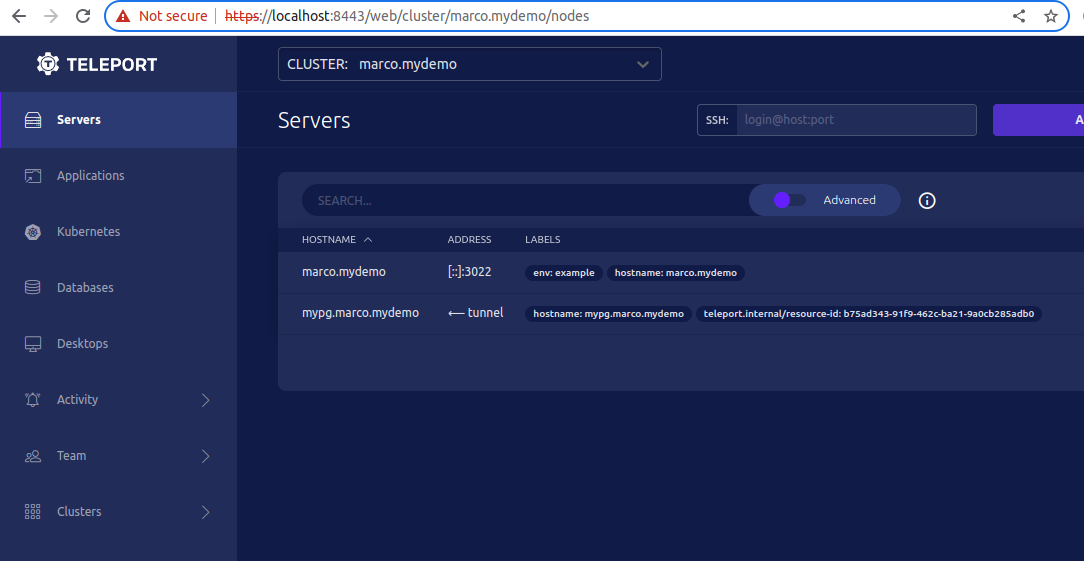
- WebUI should be able to query the Servers/Nodes which contain that
specific `<resource-id>` and allow the user to connect to it.
Demo:
The token value is provided via the HTTP request
and fed into the node join script. This could allow an attacker
to generate a node-join script with malicious code included.

Fix this by validating that tokens are valid and exist in the backend.

Additionally, we recently added the ability to specify labels via the
node-labels query parameter, which is also user-controlled. Since this
functionality was never integrated in the UI, we remove it here and
will add an alternative implementation in the future.

Also use single quotes in script to prevent expansion
 Marco André Dinis
