
22 KiB
Collection Semantics
This document describes the semantics around working with Galaxy dataset collections. In particular it describes how they operate within Galaxy tools and workflows.
:::{admonition} You Probably Don't Need to Read This :class: caution
Any significantly sophisticated workflow language will have ways to collect data into arrays or vectors or dictionaries and apply operations across this data (mapping) or reduce the dimensionality of this data (reductions). Typically, this explicitly annotated with map functions or for loops. Galaxy however is designed to be a point and click interface for connecting steps and running tools. It is important that steps just connect and just do the most natural thing - and this is what Galaxy does. This document just provides a mathematical formalism to that "what should just intuitively work" that can be used to document test cases and help with implementation. This is reference documentation not user documentation, Galaxy should just work. :::
Mapping
If a tool consumes a simple dataset parameter and produces a simple dataset parameter, then any collection type may be "mapped over" the data input to that tool. The result of that is the tool being applied to each element of the collection and "implicit collections" being created from the outputs that are produced from those operations. Those implicit collections have the same element identifiers in the same order as the input collection that is mapped over. Each element of the implicit collections correspond to their own job and Galaxy very naturally and intuitively parallelizes jobs without extra work from the user and without any knowledge of the tool.
(BASIC_MAPPING_PAIRED)= (BASIC_MAPPING_PAIRED_OR_UNPAIRED_PAIRED)= (BASIC_MAPPING_PAIRED_OR_UNPAIRED_UNPAIRED)= (BASIC_MAPPING_LIST)=
Examples
:::{admonition} Example: BASIC_MAPPING_PAIRED
:class: note
Assuming,
d_f,d_rare datasetstool \text{ is } (i: \text{ dataset }) \Rightarrow \{ o: \text{ dataset } \}Cis\text{CollectionInstance<}paired,\left\{ \text{ forward }=d_f, \text{ reverse }=d_r \right\}\text{>}
then
tool(i=\text{mapOver}(C)) \mapsto \left\{o: collection<paired, \left\{\text{forward}=tool(i=d_f)[o], \text{reverse}=tool(i=d_r)[o]\right\}> \right\}
:::
:::{admonition} Example: BASIC_MAPPING_PAIRED_OR_UNPAIRED_PAIRED
:class: note
Assuming,
d_f,d_rare datasetstool \text{ is } (i: \text{ dataset }) \Rightarrow \{ o: \text{ dataset } \}Cis\text{CollectionInstance<}paired\_or\_unpaired,\left\{ \text{ forward }=d_f, \text{ reverse }=d_r \right\}\text{>}
then
tool(i=\text{mapOver}(C)) \mapsto \left\{o: collection<paired\_or\_unpaired,\left\{\text{forward}=tool(i=d_f)[o], \text{reverse}=tool(i=d_r)[o]\right\}>\right\}
:::
:::{admonition} Example: BASIC_MAPPING_PAIRED_OR_UNPAIRED_UNPAIRED
:class: note
Assuming,
d_uis a datasettool \text{ is } (i: \text{ dataset }) \Rightarrow \{ o: \text{ dataset } \}Cis\text{CollectionInstance<}paired\_or\_unpaired,\left\{ \text{ unpaired }=d_u \right\}\text{>}
then
tool(i=\text{mapOver}(C)) \mapsto \left\{o: collection<paired\_or\_unpaired,\left\{unpaired=tool(i=d_u)[o]\right\}>\right\}
:::
:::{admonition} Example: BASIC_MAPPING_LIST
:class: note
Assuming,
d_1,...,d_nare datasetstool \text{ is } (i: \text{ dataset }) \Rightarrow \{ o: \text{ dataset } \}Cis\text{CollectionInstance<}list,\left\{ \text{ i1 }=d_1, ..., \text{ in }=d_n \right\}\text{>}
then
tool(i=\text{mapOver}(C)) \mapsto \left\{o: collection<\text{list},\left\{i1=tool(i=d_1)[o],...,in=tool(i=d_n)[o]]\right\}>\right\}
:::
The above description of mapping over inputs works naturally and as expected for nested collections.
(NESTED_LIST_MAPPING)= (BASIC_MAPPING_LIST_PAIRED_OR_UNPAIRED)=
Examples
:::{admonition} Example: NESTED_LIST_MAPPING
:class: note
Assuming,
d_1,...,d_nare datasetstool \text{ is } (i: \text{ dataset }) \Rightarrow \{ o: \text{ dataset } \}Cis\text{CollectionInstance<}list:list,\left\{ \text{ o1 }=\left\{ \text{ inner }=d_1 \right\}, ..., \text{ on }=\left\{ \text{ inner }=d_n \right\} \right\}\text{>}
then
tool(i=\text{mapOver}(C)) \mapsto \left\{o: collection<\text{list}:\text{list},\left\{o1=\left\{inner=tool(i=d_1)[o]\right\}\right\},...,\left\{on=\left\{inner=tool(i=d_n)[o]\right\}\right\}>\right\}
:::
:::{admonition} Example: BASIC_MAPPING_LIST_PAIRED_OR_UNPAIRED
:class: note
Assuming,
d_f,d_rare datasetstool \text{ is } (i: \text{ dataset }) \Rightarrow \{ o: \text{ dataset } \}Cis\text{CollectionInstance<}list:paired\_or\_unpaired,\left\{ \text{ el1 }=\left\{ \text{ forward }=d_f, \text{ reverse }=d_r \right\} \right\}\text{>}
then
tool(i=\text{mapOver}(C)) \mapsto \left\{o: collection<\text{list}:paired\_or\_unpaired,\left\{el1=\left\{\text{forward}=tool(i=d_f)[o],\text{reverse}=tool(i=d_r)[o]\right\}\right\}>\right\}
:::
For tools with multiple data inputs, the tool can be executed with individual datasets for the non-mapped over input and each tool execution will just be executed with that dataset. The dataset not mapped over serves as the input for each execution.
(BASIC_MAPPING_INCLUDING_SINGLE_DATASET)=
Examples
:::{admonition} Example: BASIC_MAPPING_INCLUDING_SINGLE_DATASET
:class: note
Assuming,
d_1,...,d_n,d_oare datasetstool \text{ is } (i: \text{ dataset }, i2: \text{ dataset }) \Rightarrow \{ o: \text{ dataset } \}Cis\text{CollectionInstance<}list,\left\{ \text{ i1 }=d_1, ..., \text{ in }=d_n \right\}\text{>}
then
tool(i=\text{mapOver}(C),i2=d_o) \mapsto \left\{o: collection<\text{list},\left\{i1=tool(i=d_1, i2=d_o)[o],...,in=tool(i=d_n, i2=d_o)[o]\right\}>\right\}
:::
If a tool consumes two input datasets and produces one output dataset, you can map two collections with identical structure (same element identifiers in the same order) over the respective inputs and the result is an implicit collection with the same structure as the inputs and where each output in the implicit collection corresponds to the tool being executed with the two inputs corresponding to that position in the input collections.
The default behavior here is the collections are linked and the act of mapping over inputs to the tool are sort of a flat map or a dot product. No extra dimensionality in the resulting collections.
From a user perspective this means if you start with a collection and apply a bunch of map over operations on tools - the results will all continue to match and work together very naturally - again without extra work by the user and without extra knowledge by the tool author.
(BASIC_MAPPING_TWO_INPUTS_WITH_IDENTICAL_STRUCTURE)=
Examples
:::{admonition} Example: BASIC_MAPPING_TWO_INPUTS_WITH_IDENTICAL_STRUCTURE
:class: note
Assuming,
d1_1,...,d1_n,d2_1,...,d2_nare datasetstool \text{ is } (i: \text{ dataset }, i2: \text{ dataset }) \Rightarrow \{ o: \text{ dataset } \}C1is\text{CollectionInstance<}list,\left\{ \text{ i1 }=d1_1, ..., \text{ in }=d1_n \right\}\text{>}C2is\text{CollectionInstance<}list,\left\{ \text{ i1 }=d2_1, ..., \text{ in }=d2_n \right\}\text{>}
then
tool(i=\text{mapOver}(C1), i2=\text{mapOver}(C2)) \mapsto \left\{o: collection<\text{list},\left\{i1=tool(i=d1_1, i2=d2_1)[o],...,in=tool(i=d1_n, i2=d2_n)[o]]\right\}>\right\}
:::
Reduction
Not all tool executions result in implicit collections and mapping
over inputs. Tool inputs of type data_collection can consume
collections directly and do not necessarily result in mapping over.
Tools that consume collections and output datasets effectively reduce the dimension of the Galaxy data structure. When used at runtime this is often referred to a "reduction" in the code.
(COLLECTION_INPUT_PAIRED)= (COLLECTION_INPUT_LIST)= (COLLECTION_INPUT_PAIRED_OR_UNPAIRED)= (COLLECTION_INPUT_LIST_PAIRED_OR_UNPAIRED)=
Examples
:::{admonition} Example: COLLECTION_INPUT_PAIRED
:class: note
Assuming,
d_f,d_rare datasetstool \text{ is } (i: \text{ collection<paired> }) \Rightarrow \{ o: \text{ dataset } \}Cis\text{CollectionInstance<}paired,\left\{ \text{ forward }=d_f, \text{ reverse }=d_r \right\}\text{>}
then
tool(i=C) \rightarrow \left\{o: dataset\right\}
:::
:::{admonition} Example: COLLECTION_INPUT_LIST
:class: note
Assuming,
d1,...,dnare datasetstool \text{ is } (i: \text{ collection<list> }) \Rightarrow \{ o: \text{ dataset } \}Cis\text{CollectionInstance<}list,\left\{ \text{ el1 }=d_1, ..., \text{ eln }=d_n \right\}\text{>}
then
tool(i=C) \rightarrow \left\{o: dataset\right\}
:::
:::{admonition} Example: COLLECTION_INPUT_PAIRED_OR_UNPAIRED
:class: note
Assuming,
d_f,d_rare datasetstool \text{ is } (i: \text{ collection<paired_or_unpaired> }) \Rightarrow \{ o: \text{ dataset } \}Cis\text{CollectionInstance<}paired\_or\_unpaired,\left\{ \text{ forward }=d_f, \text{ reverse }=d_r \right\}\text{>}
then
tool(i=C) \rightarrow \left\{o: dataset\right\}
:::
:::{admonition} Example: COLLECTION_INPUT_LIST_PAIRED_OR_UNPAIRED
:class: note
Assuming,
d_f,d_rare datasetstool \text{ is } (i: \text{ collection<list:paired_or_unpaired> }) \Rightarrow \{ o: \text{ dataset } \}Cis\text{CollectionInstance<}list:paired\_or\_unpaired,\left\{ \text{ el1 }=\left\{ \text{ forward }=d_f, \text{ reverse }=d_r \right\} \right\}\text{>}
then
tool(i=C) \rightarrow \left\{o: dataset\right\}
:::
For nested collections where each rank is a list or a paired collection,
then collection inputs must match every part of the collection type input definition.
(COLLECTION_INPUT_LIST_NOT_CONSUMES_PAIRS)= (COLLECTION_INPUT_PAIRED_NOT_CONSUMES_LIST)=
Examples
:::{admonition} Example: COLLECTION_INPUT_LIST_NOT_CONSUMES_PAIRS
:class: note
Assuming,
d_f,d_rare datasetstool \text{ is } (i: \text{ collection<list> }) \Rightarrow \{ o: \text{ dataset } \}Cis\text{CollectionInstance<}paired,\left\{ \text{ forward }=d_f, \text{ reverse }=d_r \right\}\text{>}
then
tool(i=C)\text{ is invalid}
:::
:::{admonition} Example: COLLECTION_INPUT_PAIRED_NOT_CONSUMES_LIST
:class: note
Assuming,
d_1,...,d_nare datasetstool \text{ is } (i: \text{ collection<paired> }) \Rightarrow \{ o: \text{ dataset } \}Cis\text{CollectionInstance<}list,\left\{ \text{ i1 }=d_1, ..., \text{ in }=d_n \right\}\text{>}
then
tool(i=C)\text{ is invalid}
:::
In addition to explicit collection inputs, tool inputs of type data
where multiple="true" can consume lists directly. This is likewise a
"reduction" and does not result in implicit collection creation.
(LIST_REDUCTION)=
Examples
:::{admonition} Example: LIST_REDUCTION
:class: note
Assuming,
d_1,...,d_nare datasetstool \text{ is } (i: \text{ dataset<multiple=true> }) \Rightarrow \{ o: \text{ dataset } \}Cis\text{CollectionInstance<}list,\left\{ \text{ i1 }=d_1, ..., \text{ in }=d_n \right\}\text{>}
then
tool(i=C) == tool(i=[d_1,...,d_n])
:::
Paired collections cannot be reduced this way. paired is not meant
to represent a list/array/vector data structure - it is more like a tuple.
(PAIRED_REDUCTION_INVALID)= (PAIRED_OR_UNPAIRED_REDUCTION_INVALID)=
Examples
:::{admonition} Example: PAIRED_REDUCTION_INVALID
:class: note
Assuming,
d_f,d_rare datasetstool \text{ is } (i: \text{ dataset<multiple=true> }) \Rightarrow \{ o: \text{ dataset } \}Cis\text{CollectionInstance<}paired,\left\{ \text{ forward }=d_f, \text{ reverse }=d_r \right\}\text{>}
then
tool(i=C)\text{ is invalid}
:::
:::{admonition} Example: PAIRED_OR_UNPAIRED_REDUCTION_INVALID
:class: note
Assuming,
d_f,d_rare datasetstool \text{ is } (i: \text{ dataset<multiple=true> }) \Rightarrow \{ o: \text{ dataset } \}Cis\text{CollectionInstance<}paired\_or\_unpaired,\left\{ forward=d_f, reverse=d_r \right\}\text{>}
then
tool(i=C)\text{ is invalid}
:::
Sub-collection Mapping
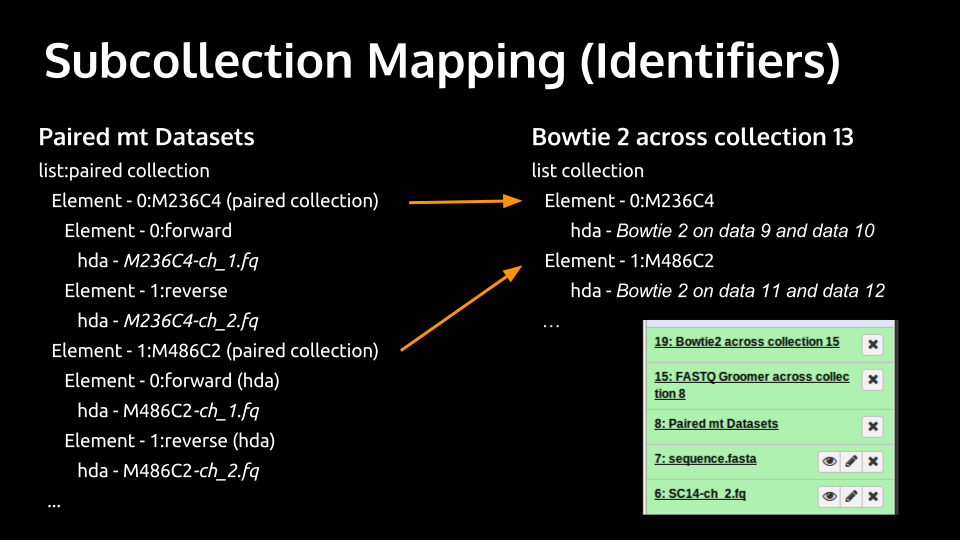
(MAPPING_LIST_PAIRED_OVER_PAIRED)=
Examples
:::{admonition} Example: MAPPING_LIST_PAIRED_OVER_PAIRED
:class: note
Assuming,
d_f,d_rare datasetstool \text{ is } (i: \text{ collection<paired> }) \Rightarrow \{ o: \text{ dataset } \}Cis\text{CollectionInstance<}list:paired,\left\{ \text{ el1 }=\left\{ \text{ forward }=d_f, \text{ reverse }=d_r \right\} \right\}\text{>}C\_PAIREDis\text{CollectionInstance<}paired,\left\{ \text{ forward }=d_f, \text{ reverse }=d_r \right\}\text{>}
then
tool(i=\text{mapOver}(C, 'paired')) \mapsto \left\{o: collection<\text{list}, \left\{el1: tool(i=C\_PAIRED)[o]\right\}>\right\}
:::
The natural extension of multiple data input parameters consuming list collections as describe
above when discussing reductions is that nested lists of lists (list:list) can be mapped
over a multiple data input parameter. Each nested list will be reduced by this operation but the
results will be mapped over. The result will be a list with the same structure as the outer list
of the input collection.
(NESTED_LIST_REDUCTION)=
Examples
:::{admonition} Example: NESTED_LIST_REDUCTION
:class: note
Assuming,
d_1,...,d_nare datasetstool \text{ is } (i: \text{ dataset<multiple=true> }) \Rightarrow \{ o: \text{ dataset } \}Cis\text{CollectionInstance<}list:list,\left\{ \text{ o1 }=\left\{ \text{ inner }=d_1 \right\}, ..., \text{ on }=\left\{ \text{ inner }=d_n \right\} \right\}\text{>}
then
tool(i=\text{mapOver}(C, '\text{list}')) \mapsto \left\{o: collection<\text{list},\left\{o1: tool(i=[d_1])[o]\right\},...,on: tool(i=[d_n])[o]\right\}>\right\}
:::
Just as a paired collection won't be reduced by a multiple data input, any sort of nested
collection ending in a paired collection cannot be mapped over such an input. So a multiple
data input parameter cannot be mapped over by a list of pairs (list:paired) for instance.
(LIST_PAIRED_REDUCTION_INVALID)= (LIST_PAIRED_OR_UNPAIRED_REDUCTION_INVALID)=
Examples
:::{admonition} Example: LIST_PAIRED_REDUCTION_INVALID
:class: note
Assuming,
d_f,d_rare datasetstool \text{ is } (i: \text{ dataset<multiple=true> }) \Rightarrow \{ o: \text{ dataset } \}Cis\text{CollectionInstance<}list:paired,\left\{ \text{ forward }=d_f, \text{ reverse }=d_r \right\}\text{>}
then
tool(i=\text{mapOver}(C, 'paired'))\text{ is invalid}
:::
:::{admonition} Example: LIST_PAIRED_OR_UNPAIRED_REDUCTION_INVALID
:class: note
Assuming,
d_f,d_rare datasetstool \text{ is } (i: \text{ dataset<multiple=true> }) \Rightarrow \{ o: \text{ dataset } \}Cis\text{CollectionInstance<}list:paired\_or\_unpaired,\left\{ \text{ forward }=d_f, \text{ reverse }=d_r \right\}\text{>}
then
tool(i=\text{mapOver}(C, 'paired\_or\_unpaired'))\text{ is invalid}
:::
paired_or_unpaired Collections
The collection type paired_or_unpaired is meant to serve as a stand-in for
an entity that can be either a single dataset or what is effectively a paired
dataset collection. These collections either have one element with identifier
unpaired or two elements with identifiers forward and reverse.
Tools can declare a data_collection input with collection type paired_or_unpaired
and that input will consume either an explicit paired_or_unpaired collection
normally or can consume a paired input.
(PAIRED_OR_UNPAIRED_CONSUMES_PAIRED)=
Examples
:::{admonition} Example: PAIRED_OR_UNPAIRED_CONSUMES_PAIRED
:class: note
Assuming,
d_f,d_rare datasetstool \text{ is } (i: \text{ collection<paired_or_unpaired> }) \Rightarrow \{ o: \text{ dataset } \}Cis\text{CollectionInstance<}paired,\left\{ \text{ forward }=d_f, \text{ reverse }=d_r \right\}\text{>}C_AS_MIXED = CollectionInstance<paired\_or\_unpaired, \left\{\text{forward}: d_f, \text{reverse}: d_r\right\}>
then
tool(i=C) == tool(i=C_AS_MIXED)
:::
This inverse of this doesn't work intentionally. In some ways a paired collection
acts as a paired_or_unpaired collection but a paired_or_unpaired is not a paired
collection. This makes a lot of sense in terms of tools - a tool consuming a paired
dataset expects to find both a forward and reverse element but these may not exist
in paired_or_unpaired collection.
(PAIRED_OR_UNPAIRED_NOT_CONSUMED_BY_PAIRED)=
Examples
:::{admonition} Example: PAIRED_OR_UNPAIRED_NOT_CONSUMED_BY_PAIRED
:class: note
Assuming,
d_f,d_rare datasetstool \text{ is } (i: \text{ collection<paired> }) \Rightarrow \{ o: \text{ dataset } \}Cis\text{CollectionInstance<}paired\_or\_unpaired,\left\{ forward=d_f, \text{ reverse }=d_r \right\}\text{>}
then
tool(i=C) is invalid
:::
The same logic holds for mapping, lists of paired datasets (list:paired) can be mapped over these
paired_or_unpaired inputs and mixed lists of pairs (list:paired_or_unpaired) cannot
be mapped over a paired input. Following the same logic, list:paired_or_unpaired cannot
be mapped over a list input or multiple data input.
(MAPPING_LIST_PAIRED_OVER_PAIRED_OR_UNPAIRED)= (PAIRED_OR_UNPAIRED_NOT_CONSUMED_BY_PAIRED_WHEN_MAPPING)= (PAIRED_OR_UNPAIRED_NOT_CONSUMED_BY_LIST_WHEN_MAPPING)=
Examples
:::{admonition} Example: MAPPING_LIST_PAIRED_OVER_PAIRED_OR_UNPAIRED
:class: note
Assuming,
d_f,d_rare datasetstool \text{ is } (i: \text{ collection<paired_or_unpaired> }) \Rightarrow \{ o: \text{ dataset } \}Cis\text{CollectionInstance<}list:paired,\left\{ \text{ el }=\left\{ \text{ forward }=d_f, \text{ reverse }=d_r \right\} \right\}\text{>}C_AS_MIXEDis\text{CollectionInstance<}list:paired\_or\_unpaired,\left\{ \text{ el }=\left\{ \text{ forward }=d_f, \text{ reverse }=d_r \right\} \right\}\text{>}
then
tool(i=\text{mapOver}(C)) == tool(i=\text{mapOver}(C_AS_MIXED))
:::
:::{admonition} Example: PAIRED_OR_UNPAIRED_NOT_CONSUMED_BY_PAIRED_WHEN_MAPPING
:class: note
Assuming,
d_f,d_rare datasetstool \text{ is } (i: \text{ collection<paired> }) \Rightarrow \{ o: \text{ dataset } \}Cis\text{CollectionInstance<}list:paired\_or\_unpaired,\left\{ \text{ el }=\left\{ \text{ forward }=f, \text{ reverse }=r \right\} \right\}\text{>}
then
tool(i=\text{mapOver}(C)) is invalid
:::
:::{admonition} Example: PAIRED_OR_UNPAIRED_NOT_CONSUMED_BY_LIST_WHEN_MAPPING
:class: note
Assuming,
d_f,d_rare datasetstool \text{ is } (i: \text{ collection<list> }) \Rightarrow \{ o: \text{ dataset } \}Cis\text{CollectionInstance<}list:paired\_or\_unpaired,\left\{ \text{ el }=\left\{ \text{ forward }=f, \text{ reverse }=r \right\} \right\}\text{>}
then
tool(i=\text{mapOver}(C)) is invalid
:::
This logic extends naturally into higher dimensional collections. A list:list:paired
can be mapped over either a paired_or_unpaired input to produce a nested list (list:list)
or a list:paired_or_unpaired input to produce a flat list (list).
In order for paired_or_unpaired collections to also act as a single dataset,
a flat list can be mapped over a such an input with a special sub collection mapping
type of 'single_datasets'.
(MAPPING_LIST_OVER_PAIRED_OR_UNPAIRED)=
Examples
:::{admonition} Example: MAPPING_LIST_OVER_PAIRED_OR_UNPAIRED
:class: note
Assuming,
d_1,...,d_nare datasetstool \text{ is } (i: \text{ collection<paired_or_unpaired> }) \Rightarrow \{ o: \text{ dataset } \}Cis\text{CollectionInstance<}list,\left\{ \text{ i1 }=d_1, ..., \text{ in }=d_n \right\}\text{>}C_AS_UNPAIRED_i = CollectionInstance<paired\_or\_unpaired,\left\{unpaired=di\right\}> for i from 1...n
then
tool(i=\text{mapOver}(C, 'single_datasets')) \mapsto \left\{o: collection<\text{list},\left\{i1=tool(i=C_AS_UNPAIRED_1)[o],...,in=tool(i=C_AS_UNPAIRED_n)[o]]\right\}>\right\}
:::
This treatment of lists without pairing extends to nested structures naturally.
For instance, a list of list of datasets (list:list) can be mapped over a
paired_or_unpaired input to produce a nested list of lists (list:list)
with a structure matching the input. Likewise, the nested list can be mapped over
a list:paired_or_unpaired input to produce a flat list with the same structure
as the outer list of the input.
Due only implementation time, the special casing of allowing paired_or_unpaired act as both datasets and paired collections only works when it is the deepest collection type. So while list:paired can be consumed by a list:paired_or_unpaired input, a paired:list cannot be consumed by a paired_or_unpaired:list input though it should be able to for consistency. We have focused our time on data structures more likely to be used in actual Galaxy analyses given current and guessed future usage.