* feat: Add stage to build logs

This adds a stage property to logs, and refactors the job logs
cliui.

It also adds tests to the cliui for build logs!

* feat: Add stage to build logs

This adds a stage property to logs, and refactors the job logs
cliui.

It also adds tests to the cliui for build logs!

* feat: Add config-ssh and tests for resiliency

* Rename "Echo" test to "ImmediateExit"

* Fix Terraform resource agent association

* Fix logs post-cancel

* Fix select on Windows

* Remove terraform init logs

* Move timer into it's own loop

* Fix race condition in provisioner jobs

* Fix requested changes
* feat: Add systemd service and production deployment

This modifies CI to use a dpkg produced from release to update and
run Coder on a tiny VM in GCP.

It's intentionally kept simple, because customers should
be able to get this same easy install experience.

* Update globalSetup.ts

* Update globalSetup.ts

* Update globalSetup.ts

* Update coder.yaml

* Use pinned version of Go
* ci: Update DataDog GitHub branch to fallback to GITHUB_REF

This was detecting branches, but not our "main" branch before.
Hopefully this fixes it!

* Add basic Terraform Provider

* Rename post files to upload

* Add tests for resources

* Skip instance identity test

* Add tests for ensuring agent get's passed through properly

* Fix linting errors

* Add echo path

* Fix agent authentication

* fix: Convert all jobs to use a common resource and agent type

This enables a consistent API for project import and provisioned resources.
* feat: Add agent authentication based on instance ID

Each cloud has it's own unique instance identity signatures, which
can be used for zero-token authentication. This change adds support
for tracking by "instance_id", and automatically authenticating
with Google Cloud.

* Add test for CLI

* Fix workspace agent request name

* Fix race with adding to wait group

* Fix name of instance identity token
* feat: Add workspace agent for SSH
This adds the initial agent that supports TTY
and execution over SSH. It functions across MacOS,
Windows, and Linux.
This does not handle the coderd interaction yet,
but does setup a simple path forward.
* Fix pty tests on Windows
* Fix log race
* Lock around dial error to fix log output
* Fix context return early
* fix: Leaking yamux session after HTTP handler is closed
Closes#317. We depended on the context canceling the yamux connection,
but this isn't a sync operation. Explicitly calling close ensures the
handler waits for yamux to complete before exit.
* Lock around close return
* Force failure with log
* Fix failed handler
* Upgrade dep
* Fix defer inside loops
* Fix context cancel for HTTP requests
* Fix resize
* Switch from memfs to built-in fstest.MapFS
* Ensure httptest servers are closed during test cleanup
* Swap ordering of expected/actual values in assertion functions
* Use http.StatusOK constants for status codes
* Add a 1-second context timeout for each request
* Use the test httptest.Server.Client() so that we can handle
  TLS server certificates if desired
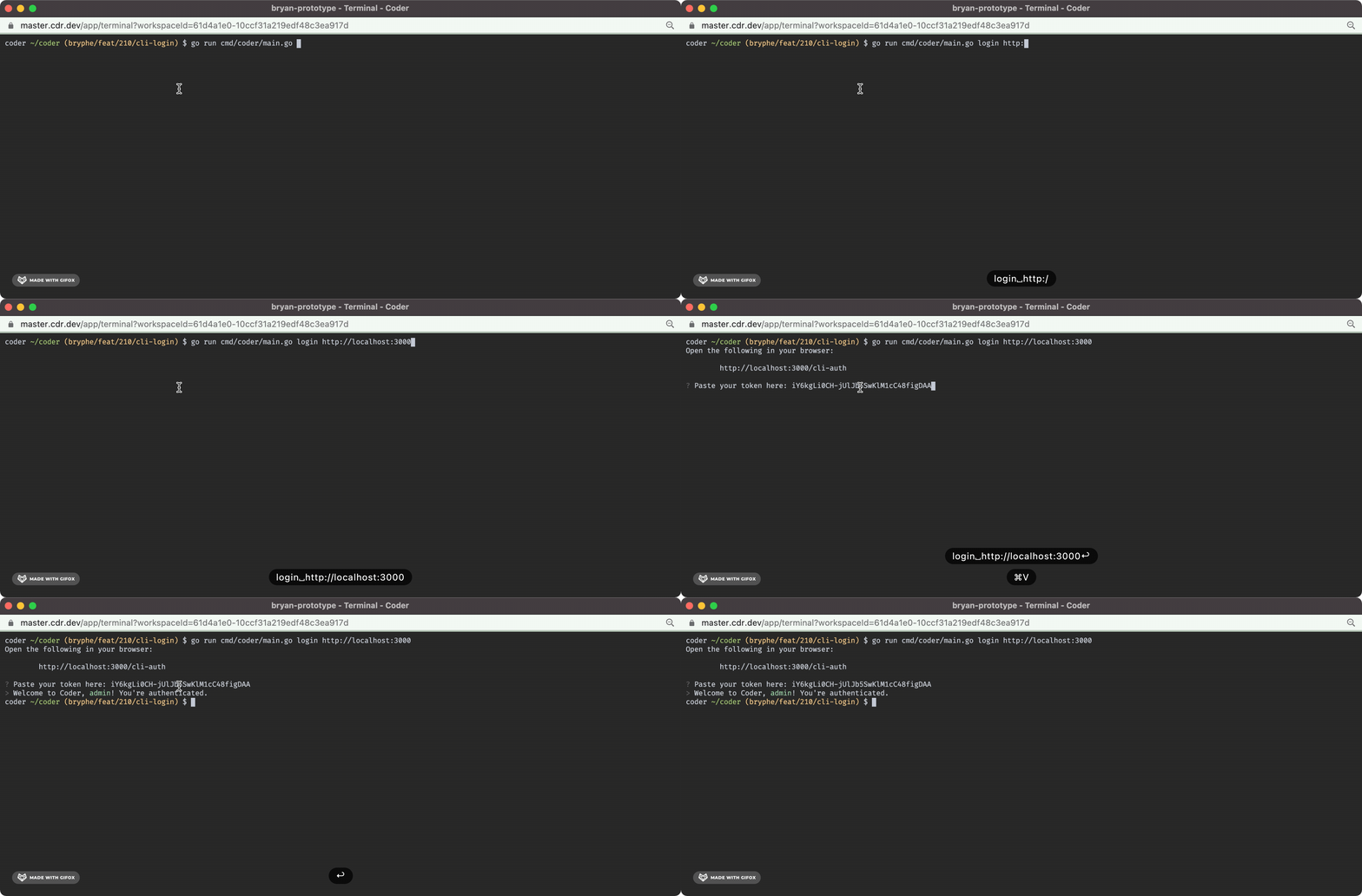
Fixes#210 - this isPR implements `coder login` in the case where the default user is already created.
This change adds:
- A prompt in the case where there is not an initial user that opens the server URL + requests a session token
- This ports over some code from v1 for the `openURL` and `isWSL` functions to support opening the browser
- A `/api/v2/api-keys` endpoint that can be `POST`'d to in order to request a new api key for a user
- This route was inspired by the v1 functionality
- A `cli-auth` route + page that shows the generated api key
- Tests for the new code + storybook for the new UI
The `/cli-auth` route, like in v1, is very minimal:
<img width="624" alt="Screen Shot 2022-02-16 at 5 05 07 PM" src="https://user-images.githubusercontent.com/88213859/154384627-78ab9841-27bf-490f-9bbe-23f8173c9e97.png">
And the terminal UX looks like this:
* Initial agent

* fix: Use buffered reader in peer to fix ShortBuffer

This prevents a io.ErrShortBuffer from occurring when the byte
slice being read is smaller than the chunks sent from the opposite
pipe.

This makes sense for unordered connections, where transmission is
not guarunteed, but does not make sense for TCP-like connections.

We use a bufio.Reader when ordered to ensure data isn't lost.

* SSH server works!

* Start Windows support

* Something works

* Refactor pty package to support Windows spawn

* SSH server now works on Windows

* Fix non-Windows

* Fix Linux PTY render

* FIx linux build tests

* Remove agent and wintest

* Add test for Windows resize

* Fix linting errors

* Add Windows environment variables

* Add strings import

* Add comment for attrs

* Add goleak

* Add require import
* Refactor parameter parsing to return nil values if none computed

* Refactor parameter to allow for hiding redisplay

* Refactor parameters to enable schema matching

* Refactor provisionerd to dynamically update parameter schemas

* Refactor job update for provisionerd

* Handle multiple states correctly when provisioning a project

* Add project import job resource table

* Basic creation flow works!

* Create project fully works!!!

* Only show job status if completed

* Add create workspace support

* Replace Netflix/go-expect with ActiveState

* Fix linting errors

* Use forked chzyer/readline

* Add create workspace CLI

* Add CLI test

* Move jobs to their own APIs

* Remove go-expect

* Fix requested changes

* Skip workspacecreate test on windows
An issue came up last week... our `embed.go` strategy doesn't handle dynamic NextJS-style routes! This is a blocker, because I'm aiming to set up CD on Monday, and the v2 UI makes heavy use of dynamic routing.

As a potential solution, this implements a go pkg `nextrouter` that serves `html` files, but respecting the dynamic routing behavior of NextJS:
- Files that have square brackets - ie `[providers]` provide a single-level dynamic route
- Files that have `[[...` prefix - ie `[[...any]]` - are catch-all routes.
- Files should be preferred over folders (ie, `providers.html` is preferred over `/providers`)
- Fixes the trailing-slash bug we hit in the previous `embed` strategy

This also integrates with `slog.Logger` for tracing, and handles injecting template parameters - a feature we need in v1 and v2 to be able to inject stuff like CSRF tokens.

This implements testing by using an in-memory file-system, so that we can exercise all of these cases.

In addition, this adjust V2's `embed.go` strategy to use `nextrouter`, which simplifies that file considerably. I'm tempted to factor out the `secureheaders` logic into a separate package, too.

If this works OK, it could be used for V1 too (although that scenario is more complex due to our hybrid-routing strategy). Based on our FE variety meeting, there's always a chance we could move away from NextJS in v1 - if that's the case, this router will still work and be more tested than our previous strategy (it just won't make use of dynamic routing). So I figured this was worth doing to make sure we can make forward progress in V2.
* chore: Rename ProjectHistory to ProjectVersion

Version more accurately represents version storage. This
forks from the WorkspaceHistory name, but I think it's
easier to understand Workspace history.

* Rename files

* Standardize tests a bit more

* Remove Server struct from coderdtest

* Improve test coverage for workspace history

* Fix linting errors

* Fix coderd test leak

* Fix coderd test leak

* Improve workspace history logs

* Standardize test structure for codersdk

* Fix linting errors

* Fix WebSocket compression

* Update coderd/workspaces.go

Co-authored-by: Bryan <bryan@coder.com>

* Add test for listing project parameters

* Cache npm dependencies with setup node

* Remove windows npm cache key

Co-authored-by: Bryan <bryan@coder.com>
 Kyle Carberry

